Relationship Status and Hindu Marriage Law

At the time of marriage, you should not have a married spouse who has not divorced his previous spouse. If you are a divorcée you can enter into a marriage again only if your divorce is complete.

Neither party should have a spouse living at the time of the marriage. You can file a civil injunction to try to stop your spouse from getting married to someone else.

If your spouse is still alive, it is a crime to be married to another person. Your first spouse can file a criminal case against you. This is an act of bigamy.1 This is not an easy process because the first spouse will have to produce concrete proof –  even another child being born out of the second marriage is not enough.

If this is proven, you might go to jail for up to 10 years and also have to pay a fine.

  1. Section 17, The Hindu Marriage Act, 1955. []

Who can Give a Child in Adoption?

Under the non-religious law on adoption,(( Juvenile Justice (Care and Protection of Children) Act, 2015.)) you cannot give up your child for adoption, but as a parent or a guardian you have the option to surrender your child.(( Section 35(1), Juvenile Justice (Care and Protection of Children) Act, 2015.)) Surrendering means you give up your child for physical, emotional or social factors beyond your control. This would end your legal relationship with the child and you will not have to bear the responsibilities and privileges that are borne out of that relation once the Child Welfare Committee (CWC) acknowledges that you have surrendered the child.(( Schedule I, Adoption Regulations, 2017.)) Thereafter, the CWC will decide what to do with the surrendered child, and may declare him/her as legally free for adoption. 


Under the Hindu law on adoption,(( Hindu Adoption and Maintenance Act, 1956.)) the following persons(( Section 9, Hindu Adoption and Maintenance Act, 1956.)) may give up a child in adoption:

  • The biological mother or father of the child, as long as the person wishing to give a child for adoption has the consent of the other biological parent. For example, if you, as the biological mother of Rama wants to give her up for adoption, you must have Rama’s biological father’s consent. This does not apply if the other parent is of unsound mind or has renounced the world or is no longer a Hindu.
  • A guardian caring for a child may give him/her up for adoption under certain conditions, with the Court’s permission. 


Maintenance under Hindu Law

Biological/Adoptive parents who are Hindu, Buddhist, Jain or Sikh and are aged or infirmed can seek maintenance from their grown children under the Hindu Adoptions and Maintenance Act if they are unable to support themselves from their own earnings or property. In addition, even when the son or daughter is no more, parents can still claim maintenance from the wealth and properties of the deceased.

What are the different procedures to get married under Christian Law?

The marriage procedure differs according to the person performing the marriage. The law does not give details of the procedure in cases where the marriage is conducted as per the rules of a particular denomination of the Church. However, when the marriage is performed by an official appointed by the Act, like a Marriage Registrar or a certified Minister of Religion, it will be performed according to the Christian Marriage law, with the relevant procedure. 

Types of Procedures:

To read more on the procedures, see our explainers on:

What are the eligibility criteria for Muslim marriages?

For a marriage to be legally recognized as a Muslim marriage, the following conditions must be met:(( Mulla, D. F., Sir. (n.d.). Principles of Mahomedan Law (20th ed.) p.251.)) 

Age 

A couple can get married if they have attained puberty (usually 15 years). 

Mental State 

A person with mental illness can get married if their guardian has given consent to the marriage. ‘Consent’ or agreeing to get married is an important part of a Muslim marriage. Even though it is assumed that a person with mental illnesses does not have the ability to get married, the law allows such marriages if the guardian agrees to it. 

Minor 

A boy or girl who has not attained puberty (minor) is not competent to enter into a contract for marriage but the guardian may contract their marriage for them after they attain puberty.(( Shoukat Hussain and another v. State of Punjab and others [CRWP No.733 of 2021 (O&M)].))

What are the essential conditions of a Muslim marriage?

There are a few essential steps that need to be followed to make the marriage valid(( Mulla, D. F., Sir. (n.d.). Principles of Mahomedan Law (20th ed.) p.331.)):

Proposal and Acceptance

There has to be a proposal made by or on behalf of one person and it has to be accepted by the other for a valid marriage.

Consent

Consent is a very important criteria for a marriage and the criteria for consent changes according to the different schools of law.

Witnesses

Witnesses are those people who are present at the marriage and can state that it took place. They are an important requirement for a valid muslim marriage.

Prohibited Relationship

Some relationships within a family and extended family are prohibited, meaning, one cannot marry these people as such relationships are prohibited under custom. There are strict prohibitions in muslim law which have to be followed.

Where can you file a divorce for a Hindu marriage?

Both you and your spouse can file a case to the Family Court. There are separate courts known as family courts which deal with divorce cases. You can approach a family court in the following areas:

Your Place of Marriage

Either you and your spouse can file for divorce in the Court of the area where your marriage ceremony took place, i.e, where your marriage was solemnized.

For example, if you and your spouse got married in Mumbai, then you can file a case at the Family Court in Mumbai.

Your Spouse’s Residence

You can file a case in the Court of the area where your spouse resides. For example, if you are filing a case against your wife who lives in New Delhi, then you can file a case in the Family Court in Delhi.

Your Last Place of Residence Together

Either you and your spouse can file for divorce in the Court of the area where you both last lived together. For example, if you and your spouse last lived together in Delhi, then either of you have the option of approaching the Family Court in New Delhi.

Your Place of Residence

Wife

If you are filing a divorce case against your husband, then you can go to the Court in the area where you are residing.

For example, if you are living in Bengaluru, you can file a case against your husband in the Family Court of Bengaluru even if your husband is not living there.

Both

If your spouse has gone abroad you can file it in your place of residence.

However, please consult your lawyer while filing the case in Court.

Mutual Divorce in Muslim Marriage

Mubara’at

Both you and your spouse can end the marriage and divorce each other if you both do not want to continue in the marriage and end all marital obligations.

What is essential in this form of divorce is that both you and your spouse should consent to ending the marriage. This form of divorce is known as Mubara’at.

The word ‘mubara’at’ means ‘freeing one another mutually’. Mutual divorce takes place in the form of ‘Mubara’at’ when:

  • Both husband and wife consent to ending the marriage
  • You (husband) have to say ‘talaq’ once
  • This form of talaq cannot be revoked.

This form of divorce happens after coming to a mutual decision to end the marriage.

If you and your spouse decide to end the marriage, this means that certain duties have to be followed such as:

  • Your wife has to follow the period of iddat after the divorce.
  • Both your wife and children can get maintenance during this period.

If you did divorce your wife using this method, then you cannot remarry her again unless certain conditions are followed.

Cancelling a Child Marriage

Where a child marriage has taken place, the person who was a child at the time of marriage has an option to cancel the marriage. You can cancel a child marriage in the following manner:

Where do you file the case?

A petition should be filed in the District Court to get the marriage annulled.

Who files the case?

If the person filing the case is a minor (below 18 years of age) then their petition has to be filed through a guardian or any other person who is interested in the child’s well being. This person will have to file the case along with the Child Marriage Prohibition Officer, who is responsible for preventing child marriages. 

When can you file the case?

It is important to note that there is a time limit to file this petition. It can only be filed within two years after the child attains majority. For girls, such a petition to strike down their marriage can only be filed till they turn 20 years old and for boys till they turn 23 years old.

What does the Court do?

When such a child marriage is cancelled, the District Court will order both the parties to return all the money, valuables, ornaments and all other gifts received during the wedding to the other side. If they are unable to return the gifts, an amount equal to the value of the gifts must be returned. 

Registration of Hindu Marriage

Registration of marriages in Hindu Law is given under Section 8 of the Hindu Marriage Act. This allows the State Government to make rules regarding registration.

The State Government may make rules about how the marriage details should be entered in the Hindu Marriage Register. The State Government can also make marriage registration compulsory in the State if it thinks this is necessary. In this case, any person violating the rule by not making an entry in the marriage register can be punished with a fine of up to Rupees twenty-five.

However, even if the entry has not been made, it does not mean that your marriage is invalid. If you take a look at the table given, you can see that each state has its own rules for Hindu marriages:


Children Legally Free for Adoption

Declaring a child legally free for adoption allows such children to be put up for adoption under the non-religious law,(( Juvenile Justice (Care and Protection of Children) Act, 2015.)) which terminates the legal relationship that the child has with their biological parents.(( Schedule I, Adoption Regulations, 2017.))  

The Child Welfare Committee (CWC) takes the decision to declare a child free for adoption, after it conducts inquiries, which includes:

  • A report by the probation officer/social worker,
  • Consent of the child (if they are old enough),
  • The required declaration submitted by the District Child Protection Unit and the Child Care Institution or Specialized Adoption Agency, etc.(( Schedule I, Adoption Regulations, 2017.)) 

The following categories of children may be declared as legally free for adoption:

  • Orphans:(( Section 38(1), Juvenile Justice (Care and Protection of Children) Act, 2015)) Children without parents (biological or adoptive) or legal guardian, or whose legal guardian is not capable or willing to take care of the child.
  • Abandoned children: Children deserted by the parents (biological or adoptive) or guardians, and who are declared as abandoned children by the Child Welfare Committee.(( Section 38(1), Juvenile Justice (Care and Protection of Children) Act, 2015.)) 
  • Surrendered children – Children who are given up by the parent/guardian, and declared as surrendered children by the Child Welfare Committee.(( Section 38(1), Juvenile Justice (Care and Protection of Children) Act, 2015.)) 
  • A child of mentally retarded parents.(( Section 38(3), Juvenile Justice (Care and Protection of Children) Act, 2015.))  
  • An unwanted child of a survivor of sexual assault.(( Section 38(3), Juvenile Justice (Care and Protection of Children) Act, 2015.))  


What is the procedure for a marriage by a person licensed to grant marriage certificates?

As per the law, a person licensed to grant Marriage certificates can only certify marriage between two Indian Christians,(( Section 60, Indian Christian Marriage Act, 1872.)) neither of them coming from the Roman Catholic faith.(( Section 65, Indian Christian Marriage Act, 1872.)) Under these provisions, any two Indian Christians can marry, without preliminary notices, if they fulfil the following conditions:

  • The bridegroom is over 21 years and the bride is over 18 years of age.(( Section 60 (1), Indian Christian Marriage Act, 1872.)) 
  • Neither of them has a wife or husband still living.(( Section 60 (2), Indian Christian Marriage Act, 1872.)) 
  • If they take the oath prescribed by the law, in front of the person licensed to grant certificates, and two other credible witnesses.(( Section 60 (3), Indian Christian Marriage Act, 1872.)) 

Upon receiving an application in person from any one of the parties, the licensed person will see whether the above criteria have been met, and shall issue a certificate for the marriage. The fee for obtaining such a certificate is four annas, that is, 25 paise. This certificate will act as conclusive proof for the validity of the marriage performed.(( Section 61, Indian Christian Marriage Act, 1872.))

What are prohibited relationships under the law?

Certain relationships are prohibited under the law. This means that a person cannot marry certain kinds of relatives:(( Mulla, D. F., Sir. (n.d.). Principles of Mahomedan Law (20th ed.) p.332.))

Blood Relations 

You cannot marry your mother, grandmother, daughter, granddaughter, sister, niece, great-niece, aunts, or great-aunts. You also cannot marry someone who is also related to you through such relatives. For example, you cannot marry your great granddaughter.

Relatives through Marriage 

You cannot marry your wife’s mother/grandmother, wife’s daughter/granddaughter, son’s wife in the case of a second, third or fourth marriage. 

Relatives through Fosterage 

All relations prohibited through blood relations and marriages apply to foster relationships as well. Example, a man cannot marry his foster mother’s daughter.


Cruel Behaviour and Hindu Marriage Law

Cruel Behavior is a ground of divorce under Hindu Marriage Law. Cruelty is behavior or conduct which causes harassment to you. Cruelty may be in two forms:

Physical

  • If your spouse physically hurts you by causing any bodily harm, then you can go to the Court to ask for a divorce. This kind of behavior amounts to physical cruelty. It is easier to prove this in Court.

Mental

  • If your spouse is causing you mental distress, because of his or her conduct or words, then this kind of behavior amounts to mental cruelty. For example, if your spouse abuses you verbally or your spouse harms your reputation in front of your friends and colleagues etc. Mental cruelty is more difficult to prove in Court as compared to physical cruelty.

The act of cruelty is gender-neutral, meaning, a husband can file the case against the wife for cruelty and vice-versa.

Child Marriages Not Recognized by Law

In certain cases under the child marriage law, the marriage would be absolutely illegal and will be considered to have not occurred in the first place. Such instances are as under: 

  • When a child is kidnapped for the purpose of marriage. 
  • When a child is enticed and taken for the purpose of marriage.
  • When a child is: 
    • Sold for the purpose of marriage
    • After marriage, the minor is sold or trafficked 
  • If the Court passed an order against a child marriage and it still takes place. 


Hindu Marriages and Mental Illness

Trigger Warning: The following content contains information which some readers may find disturbing.

The law states that people with mental illnesses usually do not have the capacity to enter into valid legal marriages. Mental illness means a substantial disorder of thinking, mood, perception, orientation or memory that severely impairs judgement, behavior, capacity to recognize reality or to meet the ordinary demands of life, and mental conditions associated with the abuse of alcohol and drugs. 1

A person planning on getting married should be able to give valid consent. If you are not able to give consent because of:

  • Unsoundness of mind; or
  • Because of a mental disorder which makes you ‘unfit for marriage and the procreation of children; or
  • If you get ‘recurrent attacks of insanity’, your marriage will not be valid.

While the provision of the law may not cover all kinds of mental illnesses, there are no proper guidelines on what kind of illnesses or the degrees of illness make you unsuitable for marriage.

  1. Section 2(s), Mental Healthcare Act, 2017. []

Types of Adoption

The types of adoption given below are only applicable to you if you decide to follow the non-religious law on adoption.(( Juvenile Justice (Care and Protection of Children) Act, 2015.)) If you follow the Hindu adoption laws,(( Hindu Adoption and Maintenance Act, 1956.)) there are no specific types of adoptions.

These are the following categories of adoption procedures:

  • Adoption by resident Indians (residing in India)
  • Adoption of a child from a foreign country by Indian citizens 
  • Adoption by Overseas Citizen of India (OCI) or a foreigner living in India
  • Adoption by OCI or Non-Resident Indian (NRI) or a foreigner living abroad 
  • Adoption by step-parent 
  • Adoption by relative
    • In-country adoption i.e. adoption within India
    • Inter-country adoption

Maintenance after death

The duty to maintain parents exists even after the death of your child or legal heir. Upon an application, the court may order that a portion of the child or legal heir’s wealth and assets be given to you, if you are old and infirm. The amount of maintenance in such cases will be calculated as per the rules of inheritance applicable after the death of your child or legal heir. The amount due to you will be decided by a court after considering a number of factors such as:

  • Full value of assets of the child or legal heir after paying off their debts including any income from their property,
  • Provisions of their will (if any),
  • Nature and closeness of the relationship with you,
  • Your needs and requirements (reasonably calculated), or
  • The number of people dependent on them for maintenance.

What is the procedure for a marriage by a Marriage Registrar?

A marriage performed by a Marriage Registrar is divided into 4 stages:

Stage 1: Issuing of Preliminary Notice

If a couple wishes to be married by a Marriage Registrar, one of them must give a notice in person to the Registrar of the district in which the couple lives. In case they live in different districts, the notice shall be given to the Registrars of both the districts. The notice shall state their intention to be married, in the prescribed format, and should mention the following:

  • The name and surname, and the profession, of each of the persons intending marriage, 
  • The current address of each of them, 
  • The time during which each has been present in the said address. In case a person has been staying there for more than a month, they only need to state the same.
  • The place where the marriage will take place.(( Section 38, Indian Christian Marriage Act, 1872.))

Given below is a sample notice:
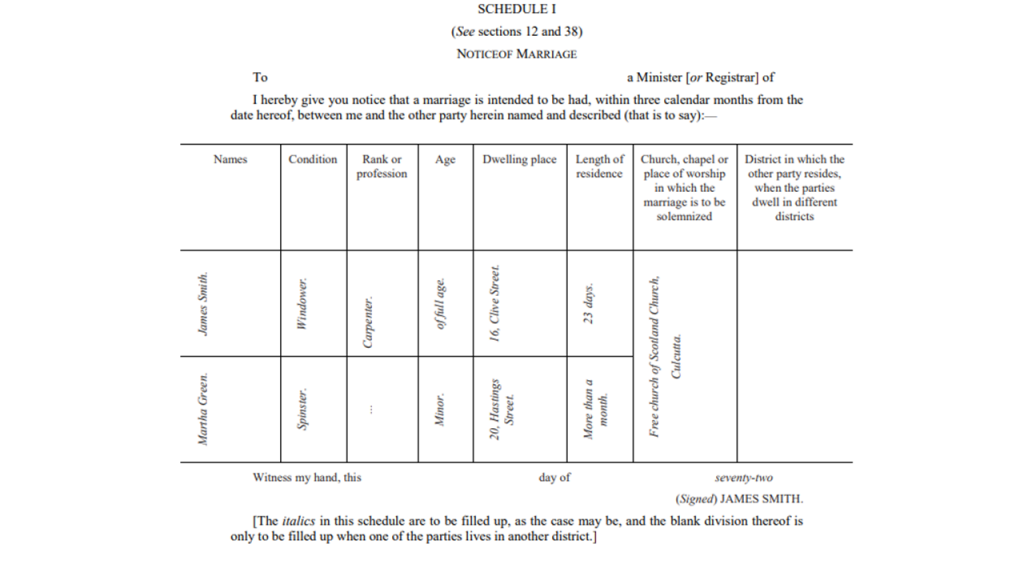
Notice Marriage Registrar

The notice will be pasted by the Registrar at a conspicuous place in the office,(( Section 39, Indian Christian Marriage Act, 1872.)) and will be entered in the Marriage Notice Book kept in the office.1

Stage 2: Issuing of certificate of receipt of notice

After at least four days of receiving the notice by the Registrar,(( Section 41, Indian Christian Marriage Act, 1872.)) one of the parties intending marriage must make an oath to the Registrar, stating that there are no legal problems in performing the marriage, and that they live within the District of the Registrar’s office.(( Section 42, Indian Christian Marriage Act, 1872.)) In case one of the parties is a minor, one of the parties must also take an oath stating that the necessary steps have been taken.(( Section 42, Indian Christian Marriage Act, 1872.)) To know more about the special procedures of marriage of a minor, read our explainer on Marriages of Minors under Christian Law.

After such a declaration has been made, the Registrar will issue a certificate to the parties, in the prescribed format, and the parties can be married by any Registrar or in the Registrar’s presence, within two months of receiving the certificate.(( Sections 41, 50-52, Indian Christian Marriage Act, 1872.)) Given below is a sample of a certificate of receipt of notice.

Stage 3: Performance of Marriage

The certificates obtained must be produced in front of the Registrar at the time of marriage.(( Section 51, Indian Christian Marriage Act, 1872.)) The marriage will be conducted either by the Registrar themselves, or any other person authorized to do the same. The marriage ceremony must be attended by two witnesses, apart from the Registrar.(( Section 51, Indian Christian Marriage Act, 1872.)) In case two months have passed from receipt of the certificate, the entire process must restart with a fresh notice.(( Section 52, Indian Christian Marriage Act, 1872.)) 

Stage 4: Registration of Marriage

After the performance of the marriage, the details of the marriage shall be entered in a register by the Registrar, in the prescribed format.(( Sections 53 & 54, Indian Christian Marriage Act, 1872.)) The entry will be signed by the Registrar, the person who performed the marriage (if marriage was performed by someone other than the Registrar), parties to the marriage, and two witnesses who had attended the ceremony.(( Section 54, Indian Christian Marriage Act, 1872.)) 

A certified copy of an entry in the marriage register, signed by the person under whose custody the register is kept, will act as evidence that the persons mentioned in the entry have been married according to the law.(( Section 80, Indian Christian Marriage Act, 1872.)) Upon payment of the prescribed fees to the Marriage Registrar, one can always inspect a marriage register which is within the custody of the said Registrar.(( Section 79, Indian Christian Marriage Act, 1872.)) 

  1. Section 40, Indian Christian Marriage Act, 1872. []

Who are the witnesses required during a Muslim marriage?

The marriage has to take place in the presence of:

  • Two male witnesses or 
  • One male and two female witnesses. 


These witnesses must be Muslims, adults and of sound mind. The Sunni School of Muslim law specifically requires two witnesses to present while the Shia School of Law does not require the presence of a witness in any matter regarding marriage.(( Mulla, D. F., Sir. (n.d.). Principles of Mahomedan Law (20th ed.) p.332.)) 

Cheating by Spouse and Hindu Marriage Law

You can file for a divorce if your spouse has cheated on you, i.e. when they have had voluntary sexual intercourse with another person. This is also referred to as adultery.

To get a divorce, you will have to prove that voluntary sexual intercourse took place between your spouse and another person.

Till recently, cheating was a crime. It is no longer a crime. However, you can still file for divorce on the grounds that your spouse has cheated on you.

Children Born Out of Child Marriages

Irrespective of whether the child marriage has been cancelled or not, as per the law, a child born out of such a marriage would be considered a legitimate child under the law. 

Custody of Children

As for the custody of such children, the district court will decide who would receive custody of the children only while hearing the petition for cancelling the marriage. 

The court will take the following into account while granting custody:

  • The welfare and the best interest of the child will be given paramount consideration by the court while deciding their custody.
  • The court may even allow the other party access to such children if it thinks it would be in the best interest of the child to do so. 
  • The District Courts can direct the husband, or in cases of minors, their parents or guardians, to pay an amount as maintenance to the girl.