Prohibited Relationships under Hindu Marriage Law

If the spouses are within the degrees of prohibited relationship, then their marriage will not be a valid marriage. The following are the kinds of prohibited marriages:

  • If one spouse is a lineal ascendant of the other. A lineal ascendant includes a father, mother, grandfather and grandmother, but also great grandfather and great grandmother and so on.
  • If one spouse is the wife or husband of a lineal ascendant or descendant of the other. A lineal descendant will include not only children and grandchildren but also great grandchildren and their children as well.
  • If the two spouses are brother and sister, uncle and niece, aunt and nephew, or first cousins.
  • If one spouse is the
    • Ex-spouse or widow(er) of your sibling; or
    • Ex-spouse or widow(er) of your father’s or mother’s sibling; or
    • Ex-spouse or widow(er) of your grandfather’s or grandmother’s sibling.

In some cases, despite a relationship being prohibited by law, a person’s custom might still permit a marriage with another person. In this case, they can get married because their custom allows them to do so

Effects of Adoption

The following are the effects of adoption, regardless of which law you have adopted under:(( Section 63, Juvenile Justice (Care and Protection of Children) Act, 2015; Sections 12, 13 and 15, Hindu Adoption and Maintenance Act, 1956.)) 

  • Child of Adoptive Parent: The child becomes the child of the adoptive parent(s), and the adoptive parent(s) become the parents of the child as if the child had been born to them, for all purposes.
  • Familial Connections of the Child: The child’s connections with the family of birth are broken off and replaced by the ties created by the adoption in the adoptive family. However, under the Hindu law on adoption, the adopted child still cannot marry any person whom the child was prohibited from marrying while in the family of birth.
  • Property Rights of the Child: Any property owned by the adopted child before the adoption shall continue to remain the child’s property, along with the obligations attached to the property (including the obligation to maintain relatives in the biological family.)

Additionally, under the Hindu law on adoption,(( Hindu Adoption and Maintenance Act, 1956.)) from the date on which the adoption order of a child becomes effective:(( Sections 12, 13 and 15, Hindu Adoption and Maintenance Act, 1956.)) 

  • Property Rights of the Child: The adopted child cannot claim ownership and deprive property which a person had before the child was adopted.  An adoption also cannot stop the adoptive father/mother from disposing of their property by transferring it during their lifetime or bestowing it by will.

Cancelling a Valid Adoption: A valid adoption cannot be cancelled by the adoptive parent or any other person. Once adopted, a child cannot reject the adoption and return to the family of birth.

Temporary maintenance for Senior Citizens

You can make an application to the court to order your children or relatives to pay you temporary maintenance (on a monthly basis). The court has to decide whether you can get temporary maintenance within 90 days of informing your children or relatives of your application. In special circumstances, they can delay this for some more time (i.e. 30 days).

This is not the final maintenance you can expect to get. The court may decide not to give you maintenance at all, or may decide to increase or decrease the amount of maintenance in the final order.

What is the procedure for a marriage by a Licensed Minister of Religion?

A marriage performed by a licensed Minister of Religion is divided into 4 stages: 

Stage 1: Issuing of Preliminary Notice 

In case two persons wish to be married by a licensed Minister of Religion, one of them must give a notice in person to the Minister, stating their intention to be married. The notice should mention the following:

  • The name and surname, and the profession or condition, of each of the persons intending marriage.
  • The current address of each of them.
  • The time during which each has been present in the said address. In case a person has been staying there for more than a month, they only need to state the same.
  • The place of marriage – either a church or a private dwelling.1

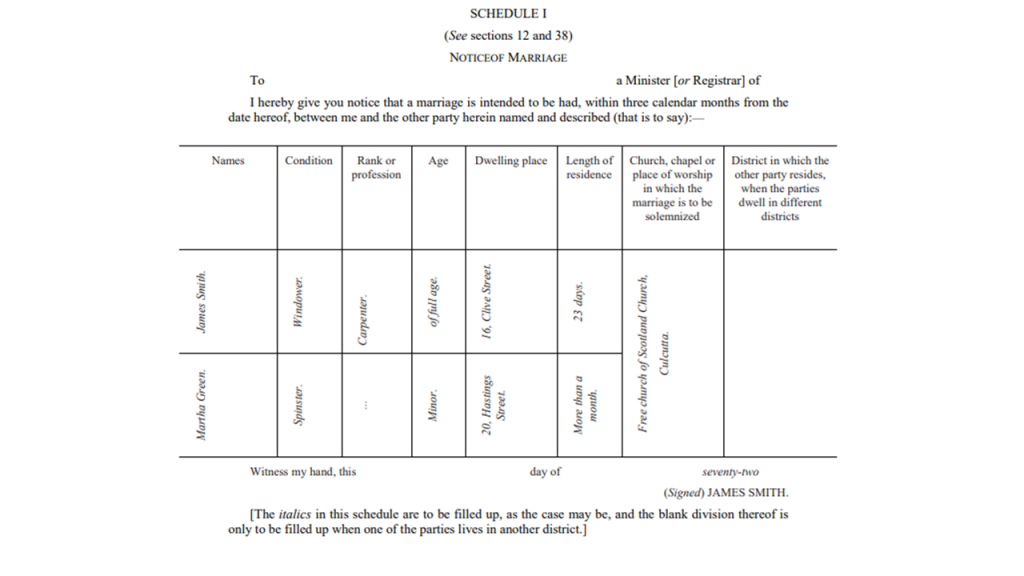
Given below is a sample notice:

Sample notice of marriage


The Minister will then paste the notice at a conspicuous or public place in the church.2 If the marriage is taking place at a private dwelling, the notice will be forwarded to the Marriage Registrar of that district, and the notice will be pasted in a conspicuous place of the Registrar’s office.(( Section 14, Indian Christian Marriage Act, 1872.)) In situations where the Minister refuses to perform a marriage, the notice will be either forwarded to another Minister, or returned to the persons who wish to get married.(( Section 15, Indian Christian Marriage Act, 1872.))

Stage 2: Issuing of certificate of receipt of notice

After at least four days of receiving the notice,(( Section 17, Indian Christian Marriage Act, 1872.)) one of the persons intending marriage must make a declaration to the Minister, stating that no legal problems exist in the marriage. In case one of the parties is a minor, they need to state that the necessary steps have been taken.(( Section 18, Indian Christian Marriage Act, 1872.)) To know more about the special procedures of marriage of a minor, read our explainer on Marriages of Minors under Christian Law.

Stage 3: Performance of Marriage

After such a declaration has been made, the Minister will issue a certificate and the Minister must conduct the marriage within two months of the couple getting the certificate.(( Section 17, 24-26, Indian Christian Marriage Act, 1872.)) Two witnesses must attend the marriage, apart from the Minister.(( Section 25, Indian Christian Marriage Act, 1872.)) In case two months have passed from receipt of the certificate, the entire process must restart with a fresh notice.(( Section 26, Indian Christian Marriage Act, 1872.))

Stage 4: Registration of Marriage

After the marriage is performed, the details of the marriage shall be entered in a register by the Minister.(( Part IV, Indian Christian Marriage Act, 1872. )) The entry will be signed by the Minister, parties to the marriage, and two witnesses who had attended the ceremony.(( Section 33, Indian Christian Marriage Act, 1872.))

A certified copy of an entry in the marriage register, signed by the person under whose custody the register is kept, will be legal evidence that the persons mentioned in the entry have been married according to the law.(( Section 80, Indian Christian Marriage Act, 1872.))

  1. Section 12, Indian Christian Marriage Act, 1872. []
  2. Section 13, Indian Christian Marriage Act, 1872. []

What is a valid marriage?

The validity of a marriage can be checked through the nikahnama, which is considered integral to a religiously-valid Islamic marriage. The Qazi will maintain the nikahnama. If there is no nikahnama then the Qazi himself can be the witness.(( Mulla, D. F., Sir. (n.d.). Principles of Mahomedan Law (20th ed.) p.332.))


The nikah can also be done though phone or the internet.(( Mulla, D. F., Sir. (n.d.). Principles of Mahomedan Law (20th ed.) p.333.))  It will be valid in cases where the parties make a proposal and acceptance before their witnesses and an advocate who is present. The witnesses and the parties must be familiar with the person appointed as the advocate and should know their name, father’s name and residential address which is also mentioned at the time of the proposal and the acceptance.


Hindu Divorce if Spouse has left you

If your spouse has left you then you can file for a divorce. This is known as desertion.

Immediate Effect of Desertion

Desertion can happen if your spouse has left you with immediate effect with an intention to never come back to stay with you as your spouse, without you agreeing to this arrangement.

This will only be understood by the Courts on a case by case basis. It is important to note that if your spouse has temporarily or in the heat of the moment left you, without actually intending to abandon you, this will not amount to desertion.

For example, if you had a fight with your husband and he leaves the house in anger then it does not mean that he has deserted you.

Causing Desertion

However, it is important that you have not created such a circumstance that any reasonable person would find so difficult to bear with that would have had to desert you. If you have created such a circumstance then the courts may not consider your case for desertion.

Other Ways of Desertion

Apart from a single act of leaving you, desertion can happen over a period of time through a course of conduct or through repeated behavioural patterns.

If your spouse has slowly withdrawn from you and your social circles (for example: stopped all interaction with you and your family though he/she may live with you) and has stopped behaving as any spouse does in a marriage (for example: refusing to financially contribute to a household since and contribute in any other way to the household) it can be understood as desertion. In such a case the spouse doesn’t have to physically leave you. Depending on the circumstances of each case, the Court can consider the desertion to begin when such behaviour started.

The Court will look at all the facts and circumstances to understand each specific case to decide on granting a divorce.

Time Period for Desertion

In order to claim desertion as a reason for divorce:

  • Your spouse should have deserted or abandoned you for two years.
  • This two year period must be continuous.

For example, Karan left his wife, Vijji, in January 2016, but changed his mind and came back to be with his wife in July 2017. Vijji cannot go to Court to file for a divorce for this reason as the two year period was not continuous.

Protection for a Married Girl Child

The law offers certain protections to girls who have been married below the age of 18 years and have filed for cancelling their marriage. 

Payment of Maintenance

The district court can direct the husband, or in cases of minors, his parents or guardians, to pay some money as maintenance to the girl. 

The Court while deciding the amount of maintenance, will keep in mind the lifestyle of the girl and the income of the person paying. This payment has to be given till the girl remarries.

Arrangements for Residence

The court can even order suitable arrangements for residence to be made for the girl until she remarries. 

Invalid/Void Hindu Marriage

Void marriages are invalid from the beginning. These do not require annulment. Under the Hindu Marriage Act, Section 11 states certain situations where the marriage is void.  The following are the situations:

  • One of the parties has a spouse living at the time of marriage. For example, if Seema was already married to Rajesh during her marriage with Rahul.
  • If the parties are within the degrees of prohibited relationship. Customs allow spouses to marry within prohibited relationships in some societies.
  • Parties are Sapindas of each other, except in cases where certain customs allow it. A sapinda relationship can be either paternal or maternal.

Procedure for Adopting a Child from a Foreign Country by Indian Citizens (Non-Religious Law)

Follow the steps given below to adopt a child from a foreign country as an Indian citizen.(( Regulation 22, Adoption Regulations, 2017.)) 

Step 1: Necessary formalities for adoption of a child from a foreign country will be completed in that country, as per their law. 

Step 2: The relevant authority, depending on the laws of the country, shall issue approval of adoption, only on receiving the required documents (please ask the authority for more details on the same), and the following reports:

Step 3: A foreign child adopted by Indian citizens and having a foreign passport, will need an Indian visa to come to India. For obtaining this visa, you can apply for it to the Indian Mission in that country. 

Step 4: The immigration clearance for the child adopted shall be obtained from the Central Government in the Foreigners’ Division, Ministry of Home Affairs, through the Indian Diplomatic Mission to that country.

Claiming Maintenance from Tribunal for Senior Citizens

You can file an application in a Maintenance Tribunal under the Maintenance And Welfare Of Parents And Senior Citizens Act, 2007. You can file with the Tribunal in the area where:

  • You live currently, or
  • Have lived in the past, or
  • Where your children or relatives live.

Once you file an application with the Tribunal, you cannot file an application for maintenance under Section 144 of the Bharatiya Nagarik Suraksha Sanhita (BNSS), 2023 (which also gives you the same right).

Process after filing an application

After you have filed an application (the format will vary from state to state), the court will first notify your children and tell them that you have filed such an application. Then, the court can decide to refer the case to a Conciliation Officer, who will try to get the parties to agree to a friendly settlement. If the court does not refer the case, it will listen to both the parties.

The court will conduct an inquiry to figure out how much maintenance you need to be paid. An inquiry is not a full-fledged legal proceeding. Even though the law does not allow for representation by lawyers in these courts, there are high court judgments which have held that this right of lawyers cannot be restricted. This court is slightly informal in nature but it has the powers of a civil court and can order attendance of witnesses, take evidence on oath, etc.

If the court finds that your children or relatives are neglecting to take care of you, it can pass an order directing them to pay a monthly maintenance. The court can also order that interest (between 5% and 8%) be paid on the maintenance amount from the date of the application. If your children or parents are not paying the maintenance even after the court order, you can go to any similar court (maintenance tribunal) and ask for help in enforcing the order.

Is the procedure for Christian Marriage the same throughout India?

The Indian Christian Marriage law, which governs the law of Christian marriages, is applicable throughout India, except in the states of Travancore-Cochin and Manipur. 

  • In Manipur, Christian marriages take place through customary rules and personal laws. 

Travancore-Cochin is currently part of the Indian states of Kerala and Tamil Nadu. In the Cochin area of Kerala, Christian marriages take place as per the Cochin Christian Civil Marriage Act of 1920.(( Alex Xavier v. State of Kerala, Kerala High Court, W. P (C) No. 24424 of 2008.)) The Travancore portion of the former State spreads across the Southern parts of Kerala and Tamil Nadu. While Tamil Nadu has extended the application of the law to the entire State, including the portions of Travancore that are now a part of Tamil Nadu,(( Section 3, The Indian Christian Marriage (Extension to Transferred Territory) Act, 1995.)) Kerala has not done the same. So, in the Southern parts of Kerala, which were previously known as the state of Travancore, Christian marriages take place according to the internal laws of the Church, which will vary across denominations.(( Sujatha v. Jose Augustine,(1994) II DMC 442 : (1994) 2 KLT 4.))

Who is a guardian under Muslim law?

The right to contract the marriage of a minor or a person with unsound mind in marriage belongs to the following sets of people who are guardians:(( Mulla, D. F., Sir. (n.d.). Principles of Mahomedan Law (20th ed.) p.330.))

  • Father.
  • Paternal grandfather how high so ever.
  • Brother and other male relations on the father’s side.

If these paternal relations are not there then the right goes to:

  • Mother.
  • Maternal Uncle or aunt and other maternal relations.

Under the Shia school of Law, the only guardians for marriage for minors are the father and the paternal grandfather.(( Mulla, D. F., Sir. (n.d.). Principles of Mahomedan Law (20th ed.) p.346.))

Hindu Marriage and Mental Illness

If you are in a Hindu marriage, the mental illness of your spouse can be a ground for divorce.

You can file for divorce if:

  • Your spouse is suffering from any mental disorder that is not curable; or
  • Your spouse has a mental disorder that occurs intermittently or continuously and this illness affects your capacity to live with them.

It is important to note that a few strong instances indicating a short temper and somewhat erratic behaviour on the part of your spouse may not amount to or be indicative of a mental disorder.

Divorce can only happen if your spouse’s mental disorder would lead to the behaviour of such a kind that you cannot reasonably be expected to live with him or her.

You can even ask the Court to direct your spouse to undergo a medical examination to ascertain that he or she is suffering from an unsound mind to prove your case.

Reporting Child Marriages

Anyone can file a complaint of child marriage, including the child. It doesn’t matter whether the child marriage has taken place or not as it can be filed at any time before or after the marriage. A complaint can be made to any of the following authorities:

Call 1098

1098 is a toll-free number and it operates across India. It is operated by the Childline India Foundation, which works for child rights and child protection. Anyone, including children themselves, can call and give information on this number. You should educate children in schools or children who are working about this helpline number so that illegal acts of child marriage can be prevented.

Police 

You can call the Police on 100 to report:

  • About a child marriage that is taking place or 
  • A child marriage that is about to take place. 

Alternatively, you can even go to a Police Station where you can file an FIR or report the complaint online.

Child Marriage Prohibition Officer

You can approach the local Child Marriage Prohibition Officer and report a child marriage to him. He will immediately proceed to take action against the persons responsible. 

Child Welfare Committee

You can even approach your local Child Welfare Committee established under the law for juvenile justice to look into the matter. For example, in Delhi you can contact the committees based on the districts.

File a Complaint with the Court

You can even directly file a complaint with the Judicial Magistrate (First Class) or the Metropolitan Magistrate. The Court will order the Police or the Child Marriage Prohibition Officer, as required to take action. 


Voidable Marriage under Hindu Marriage Law

A Hindu marriage becomes voidable in the following situations:

  • One of the spouses is impotent.
  • If the conditions for marriage have not been fulfilled. Before 1978, a guardian had to give consent on behalf of the child getting married. The reason this practice was not followed after 1978 is due to the implementation of the Child Marriage Restraint (Amendment) Act, 1978.
  • At the time of marriage, the woman was pregnant by some person other than the spouse.
  • In cases where the consent was obtained by fraud or force.

If one of these conditions are fulfilled, you can go to Court to annul your marriage.

Procedure for Adoption by Overseas Citizen of India (OCI) or a Foreigner Living in India (Non-Religious Law)

Follow the steps given below to adopt a child if you are an Overseas Citizen of India (OCI) or a foreigner who is a habitual resident of India:(( Regulation 20, Adoption Regulations, 2017.)) 


Step 1: You should determine if you can adopt. You may adopt a child through this means only if you are an OCI or a foreign citizen who is a habitual resident of India (i.e. you live in India regularly). 


Step 2: You should register online on the website of Central Adoption Resource Authority (CARA) here. It will redirect you to Child Adoption Resource Information and Guidance System (CARINGS) where you will have to fill out your application.


Step 3: Along with your application, you should submit the required documents, which are:

  • Your photograph
  • PAN Card
  • Your proof of birth (in case of a married couple, the spouse’s proof of birth too)
  • Proof of residence (Aadhar card/ voter card/ passport/current electricity bill/telephone bill) 
  • Proof of income of last year (salary slip/income certificate issued by the government/income tax return) 
  • Certificate from a medical practitioner certifying that you do not suffer from any chronic, contagious or fatal disease and they are fit to adopt (in case of a married couple, the spouse’s Medical Certificate too) 
  • Marriage certificate/Divorce Decree/ Declaration from the Court or affidavit pertaining to divorce under personal law/Death certificate of spouse, if applicable.


Step 4: A home study will be conducted by the Specialised Adoption Agency (SAA), and depending on this, your application to adopt may be accepted  or rejected. The result will be uploaded on the CARINGS website.


Step 5:  If your application is accepted, on the basis of your seniority, three children will be referred to you by the SAA through the CARINGS. You may reserve one child for possible adoption within 48 hours, and a meeting will be fixed for matching you to the child and assessing suitability. This process will be completed within twenty days, and if you do not accept the child, your name will be moved to the bottom of the seniority list. 


Step 6: The SAA will follow-up on the adoption, and create a follow-up report every six months for two years. In case of any issues, counselling will be provided, and if there is an issue after adopting the child, the child  may be taken back and declared as legally free for adoption again for other prospective adoptive parents.

How can minors marry under Christian Law?

Under Christian law, a minor is defined as someone below the age of 21 years, and is not a widow or widower. In case one of the parties intending marriage is a minor, they would require the consent of their father to get married. If the father of the party is not alive, then the consent must be given by their guardian, and if there exists no guardian, by the mother.(( Section 19, Indian Christian Marriage Act, 1872.)) In case none of them are resident in India at the time, no such consent will be needed.(( Section 19, Indian Christian Marriage Act, 1872.))

However, the Prohibition of Child Marriage Act makes every marriage involving a child (below 18 years), voidable at the option of the child.(( Section 3(1), Prohibition of Child Marriage Act, 2006.)) According to the law, the child can, if they opt to, file a petition to annul the marriage, within two years of attaining the age of majority.(( Section 3(3), Prohibition of Child Marriage Act, 2006.)) To learn more on child marriages, read our explainer on Child Marriage’. 


Procedure when marriage is performed by a licensed Minister of Religion

Given below is the general procedure followed by the Minister if a minor wants to get married under the law:

  • When a Minister receives a notice for marriage where one of the parties is a minor, they must forward the notice to the Marriage Registrar of the district.(( Section 15, Indian Christian Marriage Act, 1872.))
  • The notice will then be forwarded to the other Marriage Registrars of that district, and will be pasted on a conspicuous place in their offices.(( Section 16, Indian Christian Marriage Act, 1872.))
  • In case a person who has the authority to give consent refuses to do so, they can inform their objection towards the marriage to the concerned Minister, in writing.(( Section 20, Indian Christian Marriage Act, 1872.)) In such a case, no certificate of marriage will be issued by the Minister, unless a satisfactory enquiry has been made by the Minister into the facts.(( Section 21, Indian Christian Marriage Act, 1872.)) Such an objection must be made before the issuance of the certificate of receipt of notice.(( Section 20, Indian Christian Marriage Act, 1872.))
  • In case no objection is raised, the Minister can still wait for 14 days from the date of receiving the notice, before granting a certificate.(( Section 22, Indian Christian Marriage Act, 1872.))
  • Once a certificate is issued, the remaining procedures for performance of the marriage and registration remain the same.

Procedure when marriage is performed by or in the presence of a Marriage Registrar

Given below is the general procedure followed by a Marriage Registrar if a minor wants to get married under the law

  • When a Registrar receives a notice for marriage where one of the parties is a minor, they must forward the notice to the other Marriage Registrars of that district, and the copies of the notice will be pasted on a conspicuous place in their offices.(( Section 39, Indian Christian Marriage Act, 1872.))
  • In case a person who has the authority to give consent refuses to do so, they can inform their objection towards the marriage to the concerned Registrar, in writing.(( Sections 19 & 44, Indian Christian Marriage Act, 1872.)) In such a case, no certificate of marriage will be issued by the Registrar, unless a satisfactory enquiry has been made by the Registrar.(( Section 45, Indian Christian Marriage Act, 1872.)) Such an objection must be made before the issuance of the certificate of receipt of notice.(( Section 44, Indian Christian Marriage Act, 1872.))
  • In case the person withholding the consent is of unsound mind, or if that person (not being the father) withholds consent unjustly, the parties can approach the Court. Parties who reside in the towns of Mumbai, Chennai, and Kolkata can directly approach their respective High Courts, while others can approach the District Court for the same.(( Section 45, Indian Christian Marriage Act, 1872.))
  • Moreover, if the Registrar themself has doubts regarding the authority of the person withholding consent, the Registrar can also approach the Court.(( Section 48, Indian Christian Marriage Act, 1872.))
  • In case no objection is raised, the Registrar can still wait for 14 days from the date of receiving the notice, before granting a certificate.(( Section 41, Indian Christian Marriage Act, 1872.))
  • Once the certificate is issued, the procedure for performance of the marriage and registration remains the same.

Conversion of religion from Hinduism

Conversion 

You can file for divorce if your spouse has undergone conversion to another religion and has ceased to be a Hindu.

File a Case

It is very important to note that since your spouse has converted to another religion it does not automatically end your marriage to them. You must still file for divorce.

Even if your spouse has converted to another religion the divorce proceedings will happen under the Hindu law and not the religion your spouse converted to. This is because your marriage to your spouse happened under Hindu law.

Marrying before Filing for a Divorce

Till the divorce has been finalized by the Court your marriage will continue to exist with your spouse. Your spouse cannot marry before this and such marriage will not be a valid marriage in law.

Punishment

If your spouse marries again without getting a divorce from you then you can charge them with the offence of bigamy which is punishable with up to 7 years jail time and a fine.

Muslim Divorce if Husband Is Impotent

Under Muslim law, you can file for divorce if you find out that your husband is impotent or even if you knew throughout your marriage that your husband was impotent. In this situation your husband can do either of the following:

  • Accept in front of the Court that he is indeed impotent.
  • Deny the impotency allegation in Court and prove that he is free from any physical defect of impotency.
  • File an application to the Court to give him one year to medically fix the problem. If after a year, he is not impotent, then the Court cannot grant a divorce in your favor.

Power of the Court to Stop Child Marriage

When the Court receives credible information that a child marriage has been arranged or is about to take place, it can issue an order prohibiting the persons from conducting and organizing such marriages. 

The accused person can apply to the Court to either revoke this order or even alter it. The Court can even do this on its own motion. 

Any child marriage that takes place after the order has been issued will not be a valid marriage

Circumstances of Court Intervention

The Court can intervene: 

  • On its own; or
  • On the basis of a complaint filed by a Child Marriage Prohibition Officer or any Non-Governmental Organisation (NGO); or
  • In some cases, such as on days of Akshaya Tritiya, which is an auspicious time for marriages, the Court can also act as the Child Marriage Prohibition Officer and have all the powers of this Prohibition Officer to prevent child marriages from taking place; or 
  • Any person who has personal knowledge about a child marriage which may take place. 

Notice Issued by Court

Before passing this order the Court must issue a notice to the person accused under this law to give an opportunity to defend themselves.

However, in urgent cases, the Court has the power to issue an interim order (before the final order) stopping the marriage, without giving notice to the person(s) accused.

Punishment 

If a temporary order has been issued against you and you do not follow it, you will be punished with jail time of up to two years and/or fine up to one lakh rupees


Sapindas and Hindu Marriage

Sapinda relationships are prohibited under Hindu marriage law.  A sapinda is someone who is:

  • within or has a common ancestor relative within three generations above you on your mother’s side of the family
  • within or has a common ancestor relative within five generations above you on your father’s side of the family.

A sapinda can be someone from your father’s side or mother’s side hence, you are not eligible for a hindu marriage if you marry someone who is a Sapinda.

However, in some cases, despite a sapinda relationship being prohibited by law, a person’s custom might still permit a marriage with another person. In this case, they can get married because their custom allows them to do so.

Jail time up to one month or a fine up to Rs. 1000 or both is the punishment but there are exceptions. 

Procedure for Adoption by Resident Indians (Non-Religious Law)

As a resident Indian, you may opt for in-country adoption i.e., adoption within India. Your application for adoption will go through various stages, as mentioned below:(( Regulations 9, 10, 11, 12 and 13, Adoption Regulations, 2017.))


Step 1: You may apply for adopting a child by registering on the website of Central Adoption Resource Authority (CARA), here. It will redirect you to Child Adoption Resource Information and Guidance System (CARINGS) where you can fill your application details such as  your personal details, employment details, etc. 


Step 2: After registration, you will be required to submit relevant documents as part of your application. Please see here to understand which documents you will have to submit. After you fill out the application, you will be given an acknowledgement slip.


Step 3: Once you have filled the application with the relevant details and documents, you can track the status of your application with the registration number provided to you on the acknowledgement slip.


Step 4: A home study will be conducted by CARA or Specialized Adoption Agency (SAA), to determine whether you are eligible to adopt a child.


Step 5: Your application may be accepted or rejected. In case your application is rejected, the reasons will be posted on CARINGS, and you may appeal against that decision to the Children’s Court. Please see here for the procedure for appeal. 


Step 6: If your application is accepted, on the basis of your seniority, three children will be referred to you by the SAA through the CARINGS. You can choose one child for possible adoption within 48 hours, and a meeting will be fixed to assess suitability. This process will be completed within twenty days, and if you do not accept the child you have chosen, your name will be moved to the bottom of the seniority list. 


Step 7: Within ten days of your selection of a child, you will have to take the child in pre-adoption foster care, which makes you the child’s foster parents. This happens while the adoption approval order is pending from the Court. You should sign this undertaking before taking the child in. 


Step 8: The SAA (or other relevant authority) will file an application with the relevant Court to obtain an adoption order. If the SAA is not available in your town, the relevant authority will do this. The Court proceedings will be held in-camera, and your application will be disposed of within two months from when you filed the adoption application. Thereafter, the SAA will obtain the birth certificate of the child within three working days with your name. 


Step 9: The SAA which conducted the home study will prepare the post-adoption follow-up report every six months for two years after the adoption. In case of any issues, counselling will be provided, and if there is an issue after adopting the child, the child  may be taken back and declared as legally free for adoption again for other prospective adoptive parents.


For more information on the procedure, please see here

When and where can a Christian Marriage be performed?

Time of Marriage

A Christian marriage can only be performed between 6 AM and 7 PM.(( Section 10, Indian Christian Marriage Act, 1872.)) However, priests from the Church of England, Church of Rome, and the Church of Scotland can perform a marriage beyond these hours, as long as it is according to the rules and customs of their Church. Moreover, priests from the Church of England and Church of Rome would require a license from the bishops of their respective churches, in order to perform a marriage beyond these hours.

Place of Marriage

A Christian marriage can be performed either in a church,(( Section 13, Indian Christian Marriage Act, 1872.)) or in a private dwelling,(( Section 14, Indian Christian Marriage Act, 1872.)) or in the presence of a marriage registrar.(( Section 38, Indian Christian Marriage Act, 1872.)) However, if the marriage is being performed by a priest from the Church of England, it shall only be performed in a church.(( Section 11, Indian Christian Marriage Act, 1872.)) However, this mandate is relaxed in case there are no churches within a five-mile radius, or if the priest has obtained a special license for the purpose from the Bishop of the Church.