Maternity benefit is the amount an employer pays a woman when she is going to have a child. It helps protect the rights of women employees during pregnancy and provides them with paid leave so that they can take pregnancy leave without negative consequences.
The law has provided a detailed mechanism for filing complaints related to sexual harassment at the workplace. If you have been sexually harassed at the workplace, follow the steps given below to file a complaint for sexual harassment against your harasser.
Submit any supporting documents with the complaint
Submit the names and addresses of any witnesses who are supporting your complaint
Submit your complaint to the Internal Committee* within three months2 of the sexual harassment.
If you cannot write the complaint on your own, the Committee can help you. A complaint can be filed by someone else on your behalf, such as:3
Your relative or friend
Your co-worker
An officer of the National Commission for Women or State Women’s Commission
Any person who has knowledge of the incident, with the written consent of the victim
If you do not want to file a formal complaint they can try to work out the situation with the other person. This is called “conciliation”4
*If your workplace does not have an Internal Committee, you can go to the Local Committee that is closest to you5.
Online
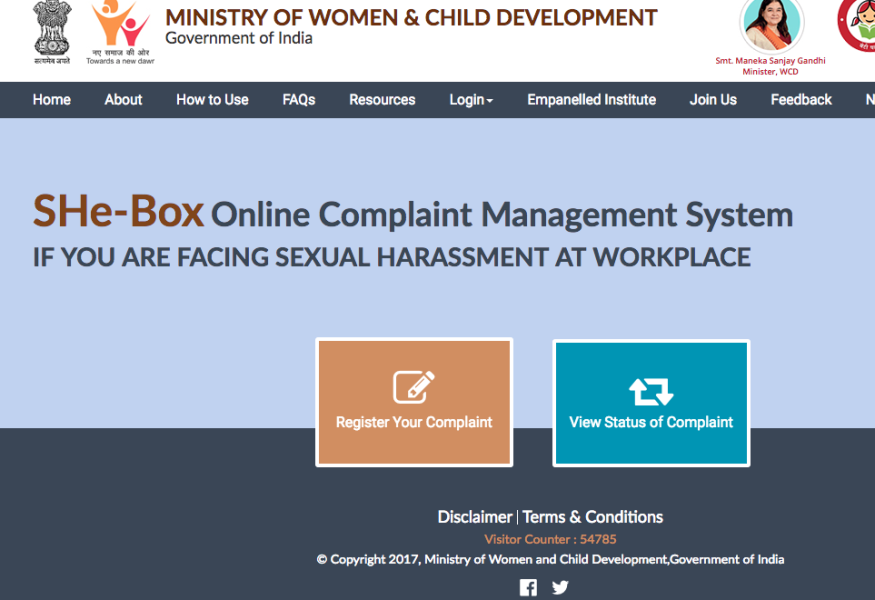
You can also complain on the website of the Ministry of Women and Child Development through the SHe-Box.
Section 7(1), Sexual Harassment of Women at Workplace (Prevention, Prohibition and Redressal) Rules, 2013; Section 9, Sexual Harassment of Women at Workplace (Prevention, Prohibition and Redressal) Act, 2013. [↩]
Section 9(1), Sexual Harassment of Women at Workplace (Prevention, Prohibition and Redressal) Act, 2013. [↩]
Section 6, Sexual Harassment of Women at Workplace (Prevention, Prohibition and Redressal) Rules, 2013. [↩]
Section 10, Sexual Harassment of Women at Workplace (Prevention, Prohibition and Redressal) Act, 2013. [↩]
Section 6(1), Sexual Harassment of Women at Workplace (Prevention, Prohibition and Redressal) Act, 2013. [↩]
You can seek maternity benefits if you are a woman and if you are:
Pregnant for the first time
Pregnant with one child or 2 children already
Adopting a child below the age of 3 months (( Section 5(4), The Maternity Benefit (Amendment) Act, 2017.))
Having a child through a surrogate (( Section5(4), The Maternity Benefit (Amendment) Act, 2017.))
Recovering from a miscarriage, abortion or tubectomy operation
You can enjoy maternity benefits such as taking a period of leave and getting paid during this period. However, you can only enjoy such benefits if you have worked for an employer for a minimum of 80 days in the last 12 months before your delivery. (( Section 5(2), The Maternity Benefit Act, 1961.)) This applies to all women who are pregnant, irrespective of age or marital status. However, this shall not apply to a woman who has immigrated into the State of Assam and was pregnant at the time of the immigration. (( Proviso, Section 5(2), The Maternity Benefit Act, 1961))
Currently, under the law, only women can seek maternity benefits. Men or persons who identify with other genders do not have an option to seek the benefits. However, you can check with the internal policy of your organization as it may provide for gender-neutral pregnancy leaves or paternity leaves.
Types of employment
Regular employee
Maternity benefit does not differentiate between permanent, temporary and contractual employees, so denying the benefit to any type of worker is against the law. (( Indu Joshi Vs. State of Uttarakhand and Ors. 2013 (139) FLR 439; Rachna Chaurasiya Vs. State of U.P. and Ors. 2017 (6) ALJ 454))
Casual/ Muster Roll employee
Courts have held that even women engaged on a casual basis, or on a muster roll basis(( Swati and Ors. Vs. Government of NCT of Delhi and Ors. 2016 (1) SLJ 201 (CAT))) on daily wages, are entitled to get the benefit of maternity leave at par with regular employees. (( Anju Sharma Vs. Lt. Governor, NCT of Delhi and Ors. In The Central Administrative Tribunal Principal Bench At New Delhi O.A. No. 543/2011; Municipal Corporation of Delhi Vs Female Workers (Muster Roll) and Ors. AIR 2000 SC 1274; Geeta Sharma Vs. Union of India RLW2001(4) Raj 637.))
Contractual employee
Maternity leave benefits are also accorded to contractual employees. (( Priyanka Gujarkar Shrivastava Vs. Registrar General and Ors. 2017 Lab IC 1646; Shanti Mehra Vs. State of Uttarakhand and Ors. 2017(2) UC 1438; State of H.P. Vs. Sudesh Kumari 2015 (145) FLR 516.)) Further, contractual employees are also entitled to 26 weeks of maternity leave. (( Jeslin Jose Vs. Cochin Port Trust 2019 (2) KHC 797)) However, a woman cannot avail maternity benefits after the expiry of the contractual period. (( Bharti Gupta Vs. Respondent: Rail India Technical and Economical Services Ltd. (Rites) and Ors. 123 (2005) DLT 138; Kavita Yadav Vs. The Secretary, Ministry of Health and Family Welfare Department W.P. (C.) No. 8884/2019 DHC.))
If you are a working woman in any capacity as given under, you will be protected from being subjected to sexual harassment at the workplace no matter the terms or conditions of employment, where they are employed or if they are simply visiting a place of work1.
The law currently only recognizes women as possible victims of sexual harassment 1. Men who face sexual harassment at work by either a woman or a man, are not protected in the same way as women. However, this varies according to the policy of the organization, which may cover men as well.
Women have legal protection if they are facing sexual harassment and can be considered any of the following:
Employee
A full-time employee
A part-time employee
A contractual employee
Working for compensation
Any woman in relation to any kind of a workplace, like an office, a household, etc.
Section 2(a), Sexual Harassment of Women at Workplace (Prevention, Prohibition and Redressal) Act, 2013. [↩]
You are entitled to leave from work when you are having a child. However, this differs based on certain circumstances:
If you are pregnant for the first time or you already have one child
You can claim a maximum of 26 weeks of leave if you are pregnant for the first time or if you already have one child. However, you cannot take more than 8 weeks of leave before the expected delivery date. (( Proviso, Section 5(3), The Maternity Benefit (Amendment) Act, 2017.))
If you already have 2 children
If you have 2 or more surviving children, then you can take 12 weeks of leave. For example, if a woman has 2 children already and is pregnant with her 3rd child, then she can take only 12 weeks of maternity leave. However, only 6 weeks, can be taken before delivery. (( Proviso, Section 5(3), The Maternity Benefit (Amendment) Act, 2017.))
Adopting a child/ Commissioning mother
A woman who legally adopts a child below the age of three months, or a commissioning mother, is entitled to maternity leave. The period of leave is for 12 weeks from the date the child is handed over to the adopting mother or the commissioning mother. (( Section 5(4), The Maternity Benefit (Amendment) Act, 2017.))
A commissioning mother is also entitled to all the benefits an employee could have post the delivery of the child, except the leave involving health of mother after delivery. (( P. Geetha Vs.The Kerala Livestock Development Board Ltd. 2015 (1) KHC 165; Sadhna Agrawal Vs. State of Chhattisgarh and Ors. 2017 Lab IC 617.))
If you are suffering from illness arising out of pregnancy, delivery, premature birth of child, miscarriage, abortion or tubectomy operation, you will be entitled to an additional month of leave with wages at the rate of maternity benefit. (( Section 10, The Maternity Benefit Act, 1961.) You will have to submit proof of the illness for the same.
According to law, several acts can be considered as sexual harassment. Most of these acts include a discernible sexual element. For example, if Seema’s boss asks her to have sex with him, or touches her in a way that makes her feel uncomfortable. Some of these acts are listed below.1:
Touching or any other form of physical contact that you do not want.
Asking for or demanding sex or any other sexual acts.
Saying things that are sexual in nature.
Showing you pornography in any form that you do not want to see, for example, videos, magazines, or books.
Any other actions that are sexual, including things that are said, things that are written, or touching.
Additionally, certain circumstances connected with any act or behaviour of sexual harassment may amount to sexual harassment of a woman. These include2:
(i) implied or explicit promise of preferential treatment in her employment; or
(ii) implied or explicit threat of detrimental treatment in her employment ; or
(iii) implied or explicit threat about her present or future employment status; or
(iv) interference with her work or creating an intimidating or offensive or hostile work
environment for her; or
(v) humiliating treatment likely to affect her health or safety.
Employers have to pay women for the period during which they are absent from work as a result of their pregnancy. This is known as a maternity benefit. (( Section 2(h), The Maternity Benefit Act, 1961.))
An employer has to pay you for a period starting from the day of your delivery to six weeks afterwards. This period also includes the day of the delivery. (( Section 5(1), The Maternity Benefit Act, 1961.))
However, you can only enjoy such benefits if you have worked for that employer for a minimum of 80 days in the last 12 months before your delivery. (( Section 5(2), The Maternity Benefit Act, 1961.))
Calculating Payment Amount/Average Wages
During this period of pregnancy, employers have to pay you the maternity benefit in the form of an average daily wage. (( Section 5(1), The Maternity Benefit Act, 1961.)) The calculation for the average daily wage is based upon the average of your wages for the 3 months before the date on which you start your pregnancy leave. The following aspects are considered while calculating wages:
To calculate the number of days a woman has worked in the 3 months before the pregnancy leave, the employer will also consider the days for which the woman was fired or laid-off or on a holiday with wages.
If the calculation given above is not possible, the wage amount is considered to be 10 rupees per day. Even if calculation is possible, the higher amount out of the two is paid to the woman. (( Explanation, Section 5(1), The Maternity Benefit Act, 1961.))
Medical Bonus
If you did not take time off before your delivery and your employer does not provide free post-natal care, you are also entitled to receive a medical bonus of 1000 rupees from your employer. (( Section 8(1), The Maternity Benefit Act, 1961.))
Sexual harassment can happen to you in these workplaces:
Government based organizations: Any establishment, such as offices, branches, undertakings, etc.that is owned, controlled, established or financed wholly or substantially by the government, local authority or a cooperative society.
Private sector based organizations: Any private establishment, such as non-governmental organizations, ventures, societies, trusts, etc., carrying on professional, commercial, vocational, educational, entertainment-based, industrial, health-based or financial activities.
Unorganized sector based workplaces: Any enterprise which works in sale of goods or provides any kind of service, where the number of employees is less than 10.
Any hospitals and nursing homes
Any household
Any sports institute, stadium, sports complex, etc., used for training, sports or related activities. This includes residential complexes also.
Any place visited by an employee due to the employment. This includes employer-provided transportation for any such journey. For example, if an employee working in an organization in Delhi needs to visit an office in Mumbai, the transportation as well as the Mumbai office will fall within the purview of this Act.
If you have faced sexual harassment1 at any of the workplaces given above, file a complaint with the Internal Committee.
For organisations under government or local authority control, employers are people appointed by the government or the local authorities to supervise and control the employees of an organization. These employers have ultimate control over the establishment.1 If no person is appointed as the employer, then the head of the department or the chief executive officer of the local authority will be considered to be the employer. In all other cases, such as privately-run organisations, whoever has the ultimate control over the organisation’s affairs or a manager, managing director, etc. are also considered employers.
Duties of employers
Employers have the following duties:
At the time of joining the employment, employers have to inform women about every maternity benefit available under the Maternity Benefit Act and within the organization.2
The employer cannot knowingly employ a woman during the 6 weeks following the date of her delivery, abortion or miscarriage.3
The maternity leave starts 6 weeks before the delivery date of the woman. However, if she requests, it can start one month before this period. During this period, the employer cannot give her arduous work, including any work that requires hours of standing or work that can negatively affect her health.4
Employers cannot dismiss women from their job during the maternity leave period.
Employers cannot deny payment of the maternity benefit to a woman eligible for such a benefit.
Punishments for Employers
Dismissal or non-payment of benefit
If an employer does not pay you the maternity benefit amount or dismisses you during your maternity leave, then he can be punished with imprisonment for up to one year and with a fine of up to Rupees Five Thousand.5
Punishment for any other violation
If your employer violates the law (The Maternity Benefit Act), then the punishment is imprisonment of up to one year, and/or a fine of up to Rupees Five Thousand.
Obstructing Inspectors
If anyone, including the employer, obstructs the Inspector from doing his duty then they will be punished with imprisonment of up to one year, and/or a fine of up to Rupees Five Thousand.6
If you are facing trouble while seeking the benefit or for any other maternity-related reason, you have a right to file a complaint. Read more here.
If someone says you have sexually harassed them, you should take it seriously. If you don’t come three times in a row to hearings your employer has set up, you may not get to speak before a decision is made1. Only women are protected from being sexually harassed at their place of work2, but sexual harassment can be done by anyone, male or female3.
Rights of Accused
You cannot be arrested without a warrant
You have the right to get a copy of the complaint within 7 working days of the complaint being filed4.
You have the right to reply. You can submit documents and a list of witnesses within 10 working days of getting the documents from the person who accused you5.
You have the right to appeal a decision made by the Internal Committee
If the Internal Committee decides that the sexual harassment claim against you is not true, you will not be punished. However, if they decide the claim is true, the Committee can give your employer or the District Officer options for how you could be punished. Please note that neither you nor the accuser will be allowed to have legal representation6.
Section 7(5), Sexual Harassment of Women at Workplace (Prevention, Prohibition and Redressal) Rules, 2013. [↩]
Section 2(a), Sexual Harassment of Women at Workplace (Prevention, Prohibition and Redressal) Act, 2013. [↩]
Section 2(m), Sexual Harassment of Women at Workplace (Prevention, Prohibition and Redressal) Act, 2013. [↩]
Section 7(2), Sexual Harassment of Women at Workplace (Prevention, Prohibition and Redressal) Rules, 2013. [↩]
Section 7(3), Sexual Harassment of Women at Workplace (Prevention, Prohibition and Redressal) Rules, 2013. [↩]
Section 7(6), Sexual Harassment of Women at Workplace (Prevention, Prohibition and Redressal) Rules, 2013. [↩]
The employer must pay you your maternity benefit before your delivery. (( Section 6(5), The Maternity Benefit Act, 1961.)) For this, you have to give your employer a written notice to state your claim to the maternity benefit. Given below is a checklist of information that should be in the notice:
You have to state that you will not work for any other employer during the time for which you have claimed the maternity benefit. (( Section 6(1), The Maternity Benefit Act, 1961.))
You can also nominate another person who can receive the payment on your behalf. (( Section 6(1), The Maternity Benefit Act, 1961.))
In case you are pregnant, the notice should state the date from which you will be absent from work. This cannot be earlier than 6 weeks before the date of your expected delivery. (( Section 6(2), The Maternity Benefit Act, 1961))
You are required to submit proof that you are pregnant.
Claiming Benefit After Delivery
Subsequently, you can claim the maternity benefit for the period after your delivery within 48 hours of submitting proof that you have delivered the child. 1 If you have not given the notice when you were pregnant, you can give the notice as soon as possible after your delivery. (( Section 6(3), The Maternity Benefit Act, 1961)) However, just because you haven’t given a notice does not mean that you will not be able to get maternity benefits. You can make an application to the inspector and he can order that the payment be made. (( Section 6(6), The Maternity Benefit Act, 1961.))
Going Back to Work
If you continue to go to work after you have been allowed to take maternity leave by your employer, then you shall have to forfeit your claim to the maternity benefit for such period. (( Section 18, The Maternity Benefit Act, 1961.))
Generally, you must file a complaint within three months of the incident of sexual harassment that you have faced. The exact date of the deadline depends on the number of sexual harassment incidents you have faced. Also, if there has been a delay in filing a complaint, in some cases, your complaint might be accepted anyway. 3 Month Period:1
One Incident of Sexual Harassment
You must file your complaint within 3 months of the incident of sexual harassment.
Multiple Incidents of Sexual Harassment
If you have been subjected/been a victim of multiple instances of sexual harassment then you must file the complaint within 3 months of the last incident of sexual harassment.
Delay in Filing a Complaint
If you cannot file a complaint within 3 months:
You can approach the Internal Committee anyway and try and explain to them why you couldn’t file the complaint.
If the Internal Committee is satisfied that there were adequate circumstances that prevented you from filing a complaint then they will accept your complaint1. This is at their discretion.
Please do act, with the help of adequate support groups, to file a complaint as soon as you are comfortable enough to do the same.
Section 9(1), Sexual Harassment of Women at Workplace (Prevention, Prohibition and Redressal) Act, 2013. [↩]
The Maternity Benefit Act will apply to you if you work in any of the following workplaces:
Any establishment such as a factory, mine or plantation, including government establishments (( Section 2(1)(a), The Maternity Benefit Act, 1961.))
Establishments employing people for the exhibition of equestrian, acrobatic and other performances (( Section 2(1)(a), The Maternity Benefit Act, 1961.))
Shops or establishments employing 10 or more people and which is covered within the laws of the state (( Section 2(1)(b), The Maternity Benefit Act, 1961.))
Any other establishment or class of establishments, industrial, commercial, agricultural units etc. that the state may notify. (( Proviso, Section 2(1),The Maternity Benefit Act, 1961.))
However, workplaces covered under the Employees’ State Insurance Act, 1948, will have to follow the maternity benefits given under this law. (( Section 2(2), The Maternity Benefit Act, 1961)) Read more here.
Working From Home
When your maternity leave is over and the nature of your work allows you to work from home, you can ask your employer to allow you to work from home. (( Section 5(5), The Maternity Benefit Act, 1961.)) This is based on you and your employer mutually agreeing on the conditions of your employment from home.
Victims of sexual harassment are entitled to specific kinds of remedies that can safeguard their work environment, and make it more comfortable for them to continue working. If you are a victim of sexual harassment you can write to the Complaints Committee to ask them to make your place of work safer by1:
Stopping the person who has been accused from reporting on your work performance and writing confidential reports about your performance and choosing someone else to do it.
Stopping the person who has been accused from supervising you if the sexual harassment incident happened in an academic setting.
Section 8, Sexual Harassment of Women at Workplace (Prevention, Prohibition and Redressal) Rules, 2013. [↩]
You cannot be dismissed or fired by your employer during or due to your maternity leave. (( Section 12(1), The Maternity Benefit Act, 1961.)) Keep in mind:
During your maternity leave, your employer cannot change your condition of work to your disadvantage. For example, your employer cannot demote you at work just because you took maternity leave.
If you are fired or dismissed during your pregnancy, you are eligible to receive maternity benefit or medical bonus.
Your employer cannot cut your salary based on the fact that you requested and did non-strenuous work during your pregnancy. Even for reasons such as taking nursing breaks, your employer cannot cut your salary. (( Section 13(b), The Maternity Benefit Act, 1961.))
You can only be dismissed or dis-entitled to your maternity benefit in cases of gross misconduct. (( Proviso, Section 12(2)(a), The Maternity Benefit Act, 1961.)) Gross misconduct means deliberately destroying an employers’ property, assaulting other employees, fraud concerning the employers’ work, etc. (( Section 8.The Maternity Benefit (Mines and Circus) Rules, 1963))
The law does not have a single punishment for all cases of Sexual Harassment at the workplace. Instead, the Committee investigating will recommend that the victim‘s employer act according to the service rules of their workplace, if it has them1. If you have an employee handbook, please refer to that to see how your employer punishes sexual harassment. If the workplace does not have service rules, then the Committee will recommend that the District Officer take action. As punishment, an offender may2:
Have to give a written apology
Be denied a raise/promotion/increment
Have to do community service
Be given a warning or censure
Lose their job
Have to get counselling
Whether or not the workplace has service rules, the Committee can also recommend that the employer take a certain amount from the offender’s salary/wages so that compensation can be paid to the woman who was harassed. If the employer cannot take money from the offender’s salary because they are not working or have left work, the Committee can order the offender to pay the victim directly. If the offender does not pay the compensation, then the Committee can ask the District Officer to get the money from the offender3.
Section 13(3)(i), Sexual Harassment of Women at Workplace (Prevention, Prohibition and Redressal) Act, 2013. [↩]
An employer has the duty to pay maternity benefit even in case the woman dies as a result of the pregnancy. If the woman dies before receiving the maternity benefit or amount, the employer shall pay the amount to the person nominated by the woman in the notice given by her. (( Section 7, The Maternity Benefit Act, 1961.)) The amount payable depends on the following:
Situation
Duty of Employer
If a woman dies during the period of her maternity leave. (( Proviso (2), Section 5(3), The Maternity Benefit Act, 1961.))
The employer needs to pay the maternity benefit only for the days up to and including the day of her death.
If a woman dies during or following her delivery but has given birth to her child.
The employer shall be liable to pay the maternity benefit for that entire period.
If the child also dies during the said period. (( Proviso (3), Section 5(3), The Maternity Benefit Act, 1961.))
The employer is liable to pay the maternity benefit until the date the child passes away, including the date of the death of the child.
As a victim, you have a right to keep your complaint and the things that happen after it private. The law guarantees that the following information is private1:
Your identity and address
The identity and address of the person you accused, as well as the witnesses
Information about the conciliation (see what this means in the Glossary) or inquiry being made by the committee
Recommendations of the Internal Committee or the Local Committee
Action taken by the employer or District Officer
All of the above information cannot be published, communicated, or made known to the public, press, or media in any way1 . If any person who is entrusted to handle the complaint, inquiry or recommendations, makes the aforementioned information public, he will be punished in accordance with the service rules of the organization.2
Section 16, Sexual Harassment of Women at Workplace (Prevention, Prohibition and Redressal) Act, 2013. [↩]
Other than the maternity pay and leave, women are entitled to other benefits. These benefits such as nursing breaks and creche facilities allow women to make an easier transition back into work after their maternity leave.
Nursing breaks
If you return to work after your delivery, you can take 2 breaks of 15 minutes each daily (( Section 6, The Maternity Benefit Act, 1961.)). You can nurse your child and take nursing breaks till the child is 15 months old. (( Section 11, The Maternity Benefit Act, 1961))
Creche Facility
Every establishment having fifty or more employees shall have a creche facility. (( Section 11A, The Maternity Benefit (Amendment) Act, 2017)) You can visit the creche 4 times in a day as per the law. (( Section 6, The Maternity Benefit (Mines and Circus) Rules, 1963.)) You can take an extra time of 5-15 minutes. This includes the time to and from the:
Creche (a nursery where babies and young children are cared for during the working day) or
Any other place where the children are being taken care of.
The Ministry of Women and Child Development issued guidelines for setting up and running creches, which prescribe standards that creches should adhere to. (( National Minimum Guidelines for Setting Up and Running Crèches under Maternity Benefit Act 2017, https://wcd.nic.in/sites/default/files/National%20Minimum%20Guidelines.pdf)) The guidelines state that there should be one crèche for every 30 children, which should be extended to any employee’s child between the age group of 6 months to 6 years. The location of the crèche facility should be at the workplace, or within 500 meters from the workplace.
Under the law, an employer has to take certain steps to create a safe work environment for women.
Women in the workplace should feel safe from sexual harassment from co-workers as well as others who might just be visiting the workplace. It’s important for employers to display the sexual harassment policy of the company where it can be seen. They also must display the order that sets up the Internal Committee so employees, as well as visitors to the workplace, can see it.
If your employer has withheld any payment or maternity benefit from you or has dismissed you on account of your maternity leave, then you can approach the following authorities:
Inspector
You can approach the inspector to make a complaint. The inspector may make an inquiry on his own or after receiving a complaint, and pass orders based on the case. (( Section 17(1) and Section 17(2), The Maternity Benefit Act, 1961.)) Commonly, the inspectors appointed under this law are labour regional commissioners. To know which officers have been designated as inspectors, click here.
You can appeal the decision of the inspector to the Labour Court. You should file the appeal within 30 days from the date on which the decision is communicated to you. (( Section 17(3), The Maternity Benefit Act, 1961.)) However, if you do not file an appeal then the decision of the inspector is final. (( Section 17(4), The Maternity Benefit Act, 1961.)) You can request the advice of a lawyer for the same.
National and State Commissions for Women
The National Commission for Women (NCW) is a national-level government organization that is empowered to investigate complaints related to issues faced by women. The NCW will help you by:
Monitoring and expediting the investigations being led by the police.
Providing counselling or a hearing before the NCW. This is done to resolve disputes between the two parties.
You can get in touch with them by either calling the helpline number 1091, or sending an email to ncw@nic.in, or filing an online complaint. Further, you can also approach the State Commission of Women situated in your state, and ask them for help.
Workplaces with more than 10 employees are required to set up a committee that specifically handles cases of Sexual Harassment. This is known as the Internal Committee. It must have1:
A presiding officer, who is a woman employed at a senior level
Three students, if the matter involves students
One member from a non-government organisation or association committed to the cause of women, or a person familiar with sexual harassment issues. This member will be paid.
Women as at least half of its members
No person in senior administrative positions as a member such as Vice-chancellor, Registrar, Dean, or head of department
A three-year term for members. Higher education institutions may also employ a system where one-third of the members change every year.
If the presiding officer acts in violation of their powers, they will be removed and a new nomination will take place2
The Internal Committee has to follow the regulations for taking complaints and making inquiries in a reasonable amount of time. The company or institution has to give the Internal Complaints Committee the things they need to make inquiries.
Section 4(2), Sexual Harassment of Women at Workplace (Prevention, Prohibition and Redressal) Act, 2013. [↩]
Section 4(5), Sexual Harassment of Women at Workplace (Prevention, Prohibition and Redressal) Act, 2013. [↩]
Proof of a pregnancy, miscarriage, abortion or tubectomy operation is necessary if you want to claim maternity benefits. You can prove the fact that you are pregnant, had a miscarriage, abortion, tubectomy operation or suffered an illness arising out of these procedures if you produce a certificate to that effect from any of the following(( Section 4, The Maternity Benefit (Mines and Circus) Rules, 1963)):
A Medical Officer of a regional hospital or a dispensary set up under the Coal Mines Welfare Organisation
Medical Officer of a Mines Board where the mine is situated.
The fact that a woman has been confined can also be proved by the production of a certified extract from a birth register or a certificate signed by a registered midwife. Additionally, a certificate signed by a registered midwife also proves miscarriage. The death of a woman can be proved by a certified extract from a death register.
False complaints made on purpose or fake documents given to the committee are taken very seriously. If a victim or someone acting for them does either of these things, they could be punished based on the service rules of the workplace. If there are no service rules, the action taken against them can be decided by the Committee1. As punishment they may2:
Have to give a written apology
Be given a warning or censure
Not be given a promotion
Not be given an increment
Lose their job
Have to have a counselling session
Have to do community service
Just because a victim is unable to provide enough proof to the Committee, it does not always make her complaint false3. The Committee will have to find out if she made a wrong complaint on purpose.
For example, if Isha makes a complaint against Rohit but there are no witnesses, documents, or anything at all that shows there was sexual harassment, her complaint will not be seen as false. But, if Isha wrote an email to a friend telling them she was lying about the harassment happening, her complaint could be seen as malicious or false.
Any woman (student, teaching, non-teaching staff) of any age at a University campus can file a complaint of sexual harassment. Apart from workplaces, Universities also must work to prevent sexual harassment.
 Family & Marriage
 Money & Property
 Crimes & Violence
 Police & Courts
 Labour & Employment
 Health & Environment
 Citizen Rights & Constitution
 Government & Elections
 Media & Intellectual Property
 Videos
 Guides
 Sample Forms
 Statewise Information
 General
 Children
 Women
Women LGBTQI+
 Employees
 Persons with Disabilities
 Scheduled Castes & Tribes
 Senior Citizens
 Informal Workers