The validity of a marriage can be checked through the nikahnama, which is considered integral to a religiously-valid Islamic marriage. The Qazi will maintain the nikahnama. If there is no nikahnama then the Qazi himself can be the witness.(( Mulla, D. F., Sir. (n.d.). Principles of Mahomedan Law (20th ed.) p.332.))
The nikah can also be done though phone or the internet.(( Mulla, D. F., Sir. (n.d.). Principles of Mahomedan Law (20th ed.) p.333.)) It will be valid in cases where the parties make a proposal and acceptance before their witnesses and an advocate who is present. The witnesses and the parties must be familiar with the person appointed as the advocate and should know their name, father’s name and residential address which is also mentioned at the time of the proposal and the acceptance.
The law offers certain protections to girls who have been married below the age of 18 years and have filed for cancelling their marriage.
Payment of Maintenance
The district court can direct the husband, or in cases of minors, his parents or guardians, to pay some money as maintenance to the girl.
The Court while deciding the amount of maintenance, will keep in mind the lifestyle of the girl and the income of the person paying. This payment has to be given till the girl remarries.
Arrangements for Residence
The court can even order suitable arrangements for residence to be made for the girl until she remarries.
Void marriages are invalid from the beginning. These do not require annulment. Under the Hindu Marriage Act, Section 11 states certain situations where the marriage is void. The following are the situations:
- One of the parties has a spouse living at the time of marriage. For example, if Seema was already married to Rajesh during her marriage with Rahul.
- If the parties are within the degrees of prohibited relationship. Customs allow spouses to marry within prohibited relationships in some societies.
- Parties are Sapindas of each other, except in cases where certain customs allow it. A sapinda relationship can be either paternal or maternal.
The Indian Christian Marriage law, which governs the law of Christian marriages, is applicable throughout India, except in the states of Travancore-Cochin and Manipur.
- In Manipur, Christian marriages take place through customary rules and personal laws.
Travancore-Cochin is currently part of the Indian states of Kerala and Tamil Nadu. In the Cochin area of Kerala, Christian marriages take place as per the Cochin Christian Civil Marriage Act of 1920.(( Alex Xavier v. State of Kerala, Kerala High Court, W. P (C) No. 24424 of 2008.)) The Travancore portion of the former State spreads across the Southern parts of Kerala and Tamil Nadu. While Tamil Nadu has extended the application of the law to the entire State, including the portions of Travancore that are now a part of Tamil Nadu,(( Section 3, The Indian Christian Marriage (Extension to Transferred Territory) Act, 1995.)) Kerala has not done the same. So, in the Southern parts of Kerala, which were previously known as the state of Travancore, Christian marriages take place according to the internal laws of the Church, which will vary across denominations.(( Sujatha v. Jose Augustine,(1994) II DMC 442 : (1994) 2 KLT 4.))
The right to contract the marriage of a minor or a person with unsound mind in marriage belongs to the following sets of people who are guardians:(( Mulla, D. F., Sir. (n.d.). Principles of Mahomedan Law (20th ed.) p.330.))
- Father.
- Paternal grandfather how high so ever.
- Brother and other male relations on the father’s side.
If these paternal relations are not there then the right goes to:
- Mother.
- Maternal Uncle or aunt and other maternal relations.
Under the Shia school of Law, the only guardians for marriage for minors are the father and the paternal grandfather.(( Mulla, D. F., Sir. (n.d.). Principles of Mahomedan Law (20th ed.) p.346.))
Anyone can file a complaint of child marriage, including the child. It doesn’t matter whether the child marriage has taken place or not as it can be filed at any time before or after the marriage. A complaint can be made to any of the following authorities:
Call 1098
1098 is a toll-free number and it operates across India. It is operated by the Childline India Foundation, which works for child rights and child protection. Anyone, including children themselves, can call and give information on this number. You should educate children in schools or children who are working about this helpline number so that illegal acts of child marriage can be prevented.
Police
You can call the Police on 100 to report:
- About a child marriage that is taking place or
- A child marriage that is about to take place.
Alternatively, you can even go to a Police Station where you can file an FIR or report the complaint online.
Child Marriage Prohibition Officer
You can approach the local Child Marriage Prohibition Officer and report a child marriage to him. He will immediately proceed to take action against the persons responsible.
Child Welfare Committee
You can even approach your local Child Welfare Committee established under the law for juvenile justice to look into the matter. For example, in Delhi you can contact the committees based on the districts.
File a Complaint with the Court
You can even directly file a complaint with the Judicial Magistrate (First Class) or the Metropolitan Magistrate. The Court will order the Police or the Child Marriage Prohibition Officer, as required to take action.
A Hindu marriage becomes voidable in the following situations:
- One of the spouses is impotent.
- If the conditions for marriage have not been fulfilled. Before 1978, a guardian had to give consent on behalf of the child getting married. The reason this practice was not followed after 1978 is due to the implementation of the Child Marriage Restraint (Amendment) Act, 1978.
- At the time of marriage, the woman was pregnant by some person other than the spouse.
- In cases where the consent was obtained by fraud or force.
If one of these conditions are fulfilled, you can go to Court to annul your marriage.
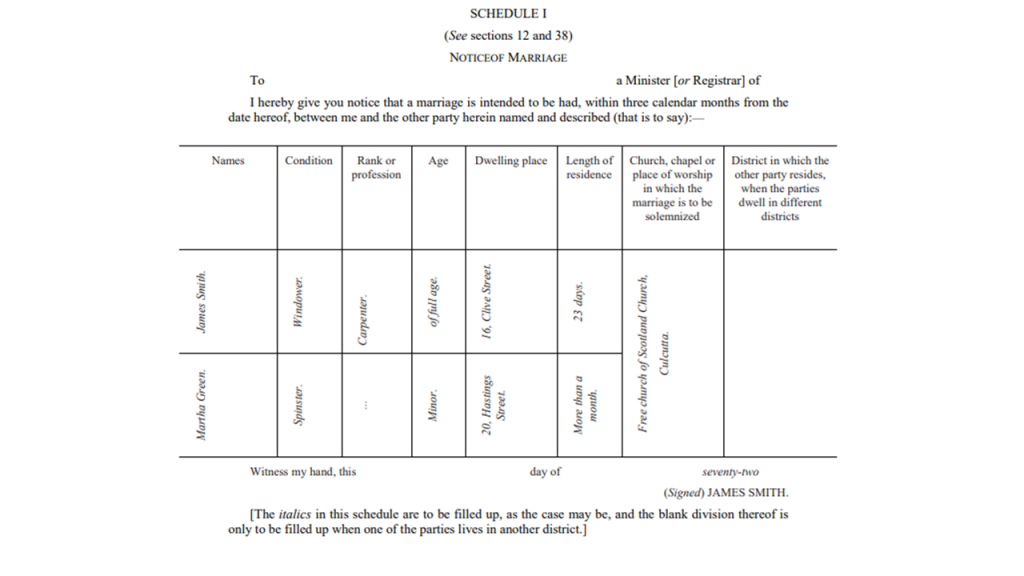
Under Christian law, a minor is defined as someone below the age of 21 years, and is not a widow or widower. In case one of the parties intending marriage is a minor, they would require the consent of their father to get married. If the father of the party is not alive, then the consent must be given by their guardian, and if there exists no guardian, by the mother.(( Section 19, Indian Christian Marriage Act, 1872.)) In case none of them are resident in India at the time, no such consent will be needed.(( Section 19, Indian Christian Marriage Act, 1872.))
However, the Prohibition of Child Marriage Act makes every marriage involving a child (below 18 years), voidable at the option of the child.(( Section 3(1), Prohibition of Child Marriage Act, 2006.)) According to the law, the child can, if they opt to, file a petition to annul the marriage, within two years of attaining the age of majority.(( Section 3(3), Prohibition of Child Marriage Act, 2006.)) To learn more on child marriages, read our explainer on ‘Child Marriage’.
Procedure when marriage is performed by a licensed Minister of Religion
Given below is the general procedure followed by the Minister if a minor wants to get married under the law:
- When a Minister receives a notice for marriage where one of the parties is a minor, they must forward the notice to the Marriage Registrar of the district.(( Section 15, Indian Christian Marriage Act, 1872.))
- The notice will then be forwarded to the other Marriage Registrars of that district, and will be pasted on a conspicuous place in their offices.(( Section 16, Indian Christian Marriage Act, 1872.))
- In case a person who has the authority to give consent refuses to do so, they can inform their objection towards the marriage to the concerned Minister, in writing.(( Section 20, Indian Christian Marriage Act, 1872.)) In such a case, no certificate of marriage will be issued by the Minister, unless a satisfactory enquiry has been made by the Minister into the facts.(( Section 21, Indian Christian Marriage Act, 1872.)) Such an objection must be made before the issuance of the certificate of receipt of notice.(( Section 20, Indian Christian Marriage Act, 1872.))
- In case no objection is raised, the Minister can still wait for 14 days from the date of receiving the notice, before granting a certificate.(( Section 22, Indian Christian Marriage Act, 1872.))
- Once a certificate is issued, the remaining procedures for performance of the marriage and registration remain the same.
Procedure when marriage is performed by or in the presence of a Marriage Registrar
Given below is the general procedure followed by a Marriage Registrar if a minor wants to get married under the law
- When a Registrar receives a notice for marriage where one of the parties is a minor, they must forward the notice to the other Marriage Registrars of that district, and the copies of the notice will be pasted on a conspicuous place in their offices.(( Section 39, Indian Christian Marriage Act, 1872.))
- In case a person who has the authority to give consent refuses to do so, they can inform their objection towards the marriage to the concerned Registrar, in writing.(( Sections 19 & 44, Indian Christian Marriage Act, 1872.)) In such a case, no certificate of marriage will be issued by the Registrar, unless a satisfactory enquiry has been made by the Registrar.(( Section 45, Indian Christian Marriage Act, 1872.)) Such an objection must be made before the issuance of the certificate of receipt of notice.(( Section 44, Indian Christian Marriage Act, 1872.))
- In case the person withholding the consent is of unsound mind, or if that person (not being the father) withholds consent unjustly, the parties can approach the Court. Parties who reside in the towns of Mumbai, Chennai, and Kolkata can directly approach their respective High Courts, while others can approach the District Court for the same.(( Section 45, Indian Christian Marriage Act, 1872.))
- Moreover, if the Registrar themself has doubts regarding the authority of the person withholding consent, the Registrar can also approach the Court.(( Section 48, Indian Christian Marriage Act, 1872.))
- In case no objection is raised, the Registrar can still wait for 14 days from the date of receiving the notice, before granting a certificate.(( Section 41, Indian Christian Marriage Act, 1872.))
- Once the certificate is issued, the procedure for performance of the marriage and registration remains the same.
When the Court receives credible information that a child marriage has been arranged or is about to take place, it can issue an order prohibiting the persons from conducting and organizing such marriages.
The accused person can apply to the Court to either revoke this order or even alter it. The Court can even do this on its own motion.
Any child marriage that takes place after the order has been issued will not be a valid marriage.
Circumstances of Court Intervention
The Court can intervene:
- On its own; or
- On the basis of a complaint filed by a Child Marriage Prohibition Officer or any Non-Governmental Organisation (NGO); or
- In some cases, such as on days of Akshaya Tritiya, which is an auspicious time for marriages, the Court can also act as the Child Marriage Prohibition Officer and have all the powers of this Prohibition Officer to prevent child marriages from taking place; or
- Any person who has personal knowledge about a child marriage which may take place.
Notice Issued by Court
Before passing this order the Court must issue a notice to the person accused under this law to give an opportunity to defend themselves.
However, in urgent cases, the Court has the power to issue an interim order (before the final order) stopping the marriage, without giving notice to the person(s) accused.
Punishment
If a temporary order has been issued against you and you do not follow it, you will be punished with jail time of up to two years and/or fine up to one lakh rupees.
Sapinda relationships are prohibited under Hindu marriage law. A sapinda is someone who is:
- within or has a common ancestor relative within three generations above you on your mother’s side of the family
- within or has a common ancestor relative within five generations above you on your father’s side of the family.
A sapinda can be someone from your father’s side or mother’s side hence, you are not eligible for a hindu marriage if you marry someone who is a Sapinda.
However, in some cases, despite a sapinda relationship being prohibited by law, a person’s custom might still permit a marriage with another person. In this case, they can get married because their custom allows them to do so.
Jail time up to one month or a fine up to Rs. 1000 or both is the punishment but there are exceptions.
Time of Marriage
A Christian marriage can only be performed between 6 AM and 7 PM.(( Section 10, Indian Christian Marriage Act, 1872.)) However, priests from the Church of England, Church of Rome, and the Church of Scotland can perform a marriage beyond these hours, as long as it is according to the rules and customs of their Church. Moreover, priests from the Church of England and Church of Rome would require a license from the bishops of their respective churches, in order to perform a marriage beyond these hours.
Place of Marriage
A Christian marriage can be performed either in a church,(( Section 13, Indian Christian Marriage Act, 1872.)) or in a private dwelling,(( Section 14, Indian Christian Marriage Act, 1872.)) or in the presence of a marriage registrar.(( Section 38, Indian Christian Marriage Act, 1872.)) However, if the marriage is being performed by a priest from the Church of England, it shall only be performed in a church.(( Section 11, Indian Christian Marriage Act, 1872.)) However, this mandate is relaxed in case there are no churches within a five-mile radius, or if the priest has obtained a special license for the purpose from the Bishop of the Church.
If you are a woman, then you have additional grounds for a divorce. You can request for the dissolution on these grounds as well:
- If your husband has married before and that wife is alive at the time of your marriage.
- If your husband has been guilty of rape, sodomy or bestiality after you got married.
- If an order has been passed against your husband awarding maintenance to you.
- If your marriage was performed before you were fifteen years and you have rejected the marriage after turning fifteen but before eighteen years of age.
Child Marriage Prohibition Officers (CMPO) are appointed by the State governments to curb issues of child marriages in each State. These officers are responsible for reporting and preventing child marriages.
The duties of the CMPO are decided and assigned by the State Government. They broadly include:
- Prevention of Child Marriage by preventing performance of child marriage by taking such action as he deems fit.
- Collection of Evidence for prosecuting persons charged under this law.
- Advising and counselling people of a locality against indulging in any child marriages in any way.
- Spreading Awareness of the problems that arise out of child marriages, such as maternal mortality, malnutrition, domestic violence, etc.
- Sensitizing the community on the issue of child marriage.
- Reporting periodical returns and statistics to the State Government on the frequency and occurrence of child marriage.
In order to effectively carry out their duties, the State Government can even confer upon the CMPO some powers of a police officer with certain conditions and limitations. This has to be done by way of a notification in the Official Gazette.
To read more about the functioning of the CMPO, please refer to this Government Handbook that explains their duties in detail. (page 19-22)
Civil marriages, also commonly called ‘Special Marriages’ or ‘Inter-religious marriages’ do not depend on the religion of the couple. Instead, the marriage happens under the Special Marriage Act where a couple practicing a different faith or religion have the right to get married in India.
To get married under this law, you need to figure out if you and your spouse are legally eligible to get married. For example, you need to be over a certain age to be able to get married and you cannot have another living spouse from whom you have not been divorced.
The following are the conditions you have to keep in mind at the time of marriage:
- Neither party has a living spouse.
- Neither party:
- is incapable of giving valid consent to the marriage in consequence of unsoundness of mind.
- though capable of giving valid consent, has been suffering from mental disorder of such a kind that they are unfit for marriage and unfit to have children.
- has been subject to recurrent attacks of insanity or epilepsy.
- The male is at least twenty-one years of age and the female is at least eighteen years of age.
- The parties are not within the degrees of prohibited relationship.
Marriages governed by customs
In cases where customs are involved for a person belonging to a tribe, community, group, or family, the State Government can make rules governing them and the solemnization of marriage. This is not needed in cases where:
- Such customs have been continuously observed for a long time among the members.
- Customs or rules are not against public policy.
- The customs or rules are applicable only to a family and the family is still continuing the practice.
In cases where the marriage is solemnized in the State of Jammu and Kashmir both parties should be citizens of India living in the territories to which the Act extends.
The process of registration for a Special Marriage is as follows:
Give notice to the Marriage Officer
- When a marriage is to be performed under this law, the parties getting married shall give notice in writing to the Marriage Officer of the district in which at least one of them has lived for at least thirty days immediately before the date of the notice. Upon receiving an application signed by both the marrying parties for the registration of their marriage, the Marriage Officer shall give public notice and allow thirty days for objections, and hear any objection received within that period.
- The Marriage Officer will keep all such notices with the records of their office and will also enter a true copy of every such notice in a Marriage Notice Book, which must be open for inspection at all reasonable times, without fee, by any person.
- The Marriage Officer shall publish every such notice by attaching a copy to some noticeable place in their office. Where either of the marrying parties is not permanently living within the district of the Marriage Officer, the Officer shall also pass on a copy to the Marriage Officer of the district where they are permanently living, and that Marriage Officer shall attach a copy to some noticeable place in their office.
Sign a declaration for marriage
- Before the marriage is performed the parties and three witnesses will sign a declaration in the presence of the Marriage Officer, and the declaration will also be signed by the Marriage Officer. The declaration is in the form specified in the Third Schedule of the Act.
Performance of Marriage and Marriage Certificate
- When the marriage has been performed and all the conditions are fulfilled, the Marriage Officer will enter the details in a certificate in the Marriage Certificate Book. This certificate will be signed by the parties getting married and the three witnesses. The Certificate will then be unquestionable evidence that a legal marriage has been performed and that all formalities regarding the signatures of witnesses have been followed.
If the marriage has been performed under any other Act, the Magistrate can still register the marriage under this Act, if an application for the same is made by both parties.
There is no specific form or essential ceremony for a marriage under Special Marriage Act, but there are two possibilities:
When you and your spouse do not want religious ceremonies
- The parties can choose not to perform any religious ceremony and merely register their marriage before the Marriage Officer. You can decide how to perform the marriage but you and your spouse have to say the following to each other: ‘I, [your name] take thee [your spouse’s name] to be my lawful wife/husband.’ This has to be done in front of the Marriage Officer and three witnesses, in a language that both parties can understand.
When you and your spouse want religious ceremonies for your wedding
- You can perform any religious ceremony (according to the personal law) and then register your marriage under the Special Marriage Act. There is one condition: you and your spouse should have been living as husband and wife from the date of the ceremony until the date of registration.
A marriage officer is a person appointed by the State Government after notification in the Official Gazette. The main duty of a marriage officer is to facilitate the registration and provide the certificate of marriage to the parties.