 Family & Marriage
 Money & Property
 Crimes & Violence
 Police & Courts
 Labour & Employment
 Health & Environment
 Citizen Rights & Constitution
 Government & Elections
 Media & Intellectual Property
 Videos
 Guides
 Sample Forms
 Statewise Information
 General
 Children
 Women
Women LGBTQI+
 Employees
 Persons with Disabilities
 Scheduled Castes & Tribes
 Senior Citizens
 Informal Workers
“Adhikaar,” recorded by MC Mawali, brings the voice of India’s young citizens to the forefront, drawing on Nyaaya’s work to make the law simple, accessible, and actionable for all.
Theme: Fundamental Rights
Guide to Admissions in Elementary Schools
How can this guide help you?
The objective of this guide is to provide actionable information on the admissions process in elementary schools in Karnataka under the Right of Children to Free and Compulsory Education Act, 2009. It aims to provide information on the admission cycle in elementary schools and help stakeholders navigate legal processes in case of any violation of their right to education, with specific focus on the rights of children with disabilities.
- This guide serves the following purposes:
- Provide information on the rights of children for parents of children studying in elementary schools
- Provide information to NGOs and CSOs working in the field of education to enable them to conduct awareness activities
- Provide a template for creating such a guide for other states Provide information on the duties and responsibilities of school administrators and teachers
This guide has been prepared by the Education Team at the Vidhi Centre for Legal Policy in collaboration with Nyaaya.
What are the laws discussed in this guide?
- Right of Children to Free and Compulsory Education Act, 2009
- Right of Children to Free and Compulsory Education Rules, 2010
- Karnataka Right of Children to Free and Compulsory Education Rules, 2012
- Rights of Persons with Disabilities Act, 2016
- Rights of Persons with Disabilities Rules, 2017
- Karnataka State Rights of Persons with Disabilities Rules, 2019
Click on the link above to download the PDF of the Guide and share with other citizens to #BeALegalChampion!
Online RTI Application


How can the guide help you?
The Nyaaya Guide on Online RTI Applications provides applicants with the steps to take when seeking information under the Right To Information Act, 2005. This guide summarises the processes involved in filing an RTI application online, appeals against certain authorities’ decisions, as well as complaint mechanisms for any online grievances. This guide also serves to inform citizens of their rights in seeking information from the central and state governments through their online portals.
What are the laws being discussed in the guide?
The Nyaaya Guide on Online RTI Applications explains the Right to Information Act, 2005, and the Right to Information Rules, 2012.
Resources
Contact Information
The Helpline and email address are for queries faced while filing the online RTI through the portal.
- 011-24622461 (9:00 AM to 5:30 PM, Monday to Friday except for Public Holidays)
- helprtionline-dopt@nic.in
The Helpline and email address are for queries faced while filing the online RTI through the portal.
- 011-24622461 (9:00 AM to 5:30 PM, Monday to Friday except for Public Holidays)
- helprtionline-dopt@nic.in
Checklists
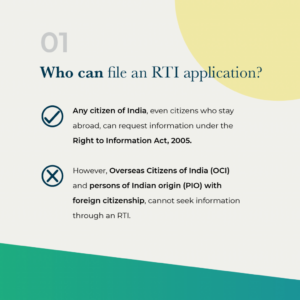
- Check whether the applicant is eligible to file an RTI depending on their citizenship and residency status.
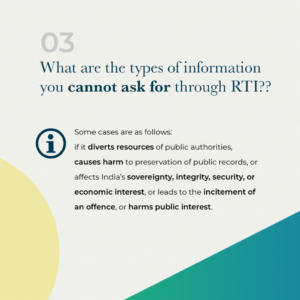
- Check whether the information required is exempt from disclosure for any reason whatsoever.
- Check whether the applicant has addressed the RTI application to the correct public authority.
- Check whether the applicant falls under the category of Below Poverty Line. If yes, such applicants are not required to pay application fees. If not, applicants are required to pay a fee of Rs. 10 with their application.
- Check that the applicant adheres to the timeline for the online first and second appeal, if made.
Source of Information
- Guideline
User Manual – Online RTI Application – https://rtionline.gov.in/um_citizen.pd
Right to Information Act, 2012
Right to Information Act, 2005
- Important Links
RTI Sample Application Form – https://onlinerti.com/rti-forms/Center.pdf
RTI FAQs – https://rtionline.gov.in/faq.php
First Appeal Portal – https://rtionline.gov.in/
Second Appeal Information – https://cic.gov.in/second-appeal-guidelines
Will my RTI be more effective if I file it through a lawyer?
No, it does not make any difference. The PIO will still consider it as filed by you.
Can I go to an ordinary civil court if I have a problem with my RTI application?
No, all disputes should be resolved by the bodies created under this Act such as the officer in charge of an appeal in a public authority or a Central/State Information Commission.
Can a Public Information Officer release information belonging to third parties under the RTI Act?
If the RTI application you have made is in relation to confidential information belonging to a third party which was supplied to the public authority, the PIO has to follow certain steps.
- The PIO has to send a notice to the third party within 5 days of getting the application.
- The third party has 10 days to agree with or object to the PIO releasing its confidential information to you.
After giving the third party an opportunity to make its submissions, the PIO has to make a decision on whether to disclose the information to you within 40 days of receiving the application. The PIO will at the same time send a notice to the third party regarding her decision – the third party has the option to appeal against this decision.
What will happen if only a portion of the information I sought through the RTI Act, is exempted under the law? Will I get the non-exempted information?
If the information contained in the record can be separately provided (not containing the exempted information), then the public authority should give you the information in response to your request. For example, details regarding vendors for the purchase of defence equipment can be provided separately from details regarding the defence equipment being deployed during a conflict.
In such a case, the PIO has to give you a notice containing the following details:
- Fact that only a portion of the records you asked for is being provided (the exempted information has been removed from the record)
- Reasons for why this decision was made
- Name and designation of the person who gave the decision
- Details of fees to be paid and
- Your right to review this decision (including details of the appellate authorities/ officers and fees to be paid).
What if someone is below the poverty line and cannot pay the RTI fees?
The person will not be required to pay and the information will be provided free of charge.
What will happen if a person with disabilities has sought information under the RTI law?
The PIO should take care to ensure that the information is provided in such a way that the person can access it. For example, if the applicant is blind, the PIO should deliver the information in Braille.
Is the Public Information Officer the only officer responsible for giving information under the RTI law?
While applications for information are made only to the PIO/APIO, every officer in the public authority has a duty to help the PIO/APIO if she asks for help. If she does not help, she can be held liable under this Act just like the PIO/ APIO.
To whom do you address your RTI application to?
You need to address the application to the Central/ State PIO or the Central/State APIO. The APIO can take 5 extra days to process the application.
Is it compulsory for a public authority to have a Public Information Officer(PIO)/Assistant PIO, per the RTI Act?
Yes, all public authorities must have a Public Information Officer (PIO) and an Assistant Public Information Officer (APIO) for each of its offices. Depending on whether the public authority falls under the Central or State Government, the PIO will be called the Central PIO or the State PIO.
Central or State Assistant Public Information Officers were also appointed at the sub-divisional or sub-district level.
Can I get information from a public authority in Jammu and Kashmir through the Right to Information Act?
No, this act does not apply to the state of Jammu and Kashmir. However, Jammu and Kashmir has its own Right To Information Act, 2009 and you can file under it.
My child is in a school and is getting education free of cost, but I need to transfer to another city. Will my child get free education in that city? What procedure should I follow?
A child may also seek transfer to another school for any reason whatsoever for completing his/her elementary education. Such transfers may be to any school, in any state in India, except for specific category schools and unaided private schools. The head-teacher or in-charge of the previous school shall immediately issue a transfer certificate, if the same is sought. If the head-teacher or in-charge of the school delays the issuance of a transfer certificate, he/she shall be liable for disciplinary action under the service rules applicable.(( Section 5, The Right of Children to Free and Compulsory Education Act, 2009.))
Furthermore, the delay in production of the transfer certificate cannot be made a ground for delaying or denying admission to a new school.(( Provisio 1, Section 5, The Right of Children to Free and Compulsory Education Act, 2009.)) Consequently, even if they don’t have documents like a transfer certificate and age proof, children must be given admission to a school.
If a school is derecognised by the Government, what happens to the children studying in that school, under the law on Free and Compulsory Education?
The children will get admission in a nearby government school.
Is it compulsory for parents to send their children to school?
The word ‘compulsory’ means that it is compulsory for the government to give free education to all children. It does not mean it is compulsory for parents to send their children to school.
How is the Child’s age determined for admissions in schools under right to education law?
For the purposes of admission to elementary schools under the Right to Education law, the age of the child is determined by way of an age of proof. The age of proof may include the child’s birth certificate or any other document which may be prescribed. In some cases the parents are required to confirm the child’s age by a written declaration or an affidavit. However, the child cannot be denied admission in case of a lack of proof towards age.1
- Section 14, The Right of Children to Free and Compulsory Education Act, 2009. Application Form For Admission In Govt./Govt. Aided School Directorate Of Education, Govt. Of Nct Of Delhi, available at, http://edudel.nic.in/upload/upload_2019_20/admission_form_28022019.PDF [↩]
Can my child get free pre-elementary education?
If the government has made the necessary arrangements for providing pre-school education to children between the ages of 3 and 6, then the child can get pre-elementary education, however, this is not compulsory.(( Section 11, The Right of Children to Free and Compulsory Education Act, 2009.)) In case, these schools have provisions for pre-elementary education, then they need to provide the same for free.
The government shut the school my child was studying in. What can I do?
If the government shuts down the school a child is currently studying in, in its order for shutting down, the government shall provide the directions regarding other neighbourhood schools that children of a closing school shall be admitted into.(( Section 18(3), The Right of Children to Free and Compulsory Education Act, 2009.))
In case of a failure of the government in providing for such directions, you may approach the local authorities or another neighbourhood school.
Will private schools get any money from the government for giving free education to 25% of the children?
Yes. The government will pay them the amount they spend on every child or its own per-child expenditure – whichever is lower.
Is pre-school education or education before first standard compulsory for children?
Governments can provide pre-school education to children between the ages of 3-6 years. However, it is not compulsory for them to do so.
What are religious schools and does the law on right to education of children, apply to such schools?
They are schools which give religious education, like Madrasas and Vedic Pathshalas. They are not obligated to provide free education.
What is the school management committee?
All schools run by the government or substantially aided by Government, including private schools, are mandated to form a School Management Committee (SMC). The SMC composes of the elected representatives of the local authority and the parents, with ¾th of the committee composed of parents of the children admitted in school. The SMC is devised to monitor the working of the school, prepare development plans for the school, monitor utilisation of grants for the school etc. However, the SMC for minority schools and aided schools shall perform advisory functions only. The SMC is vested with the responsibility of devising a School Development Plan, based on which the school shall receive grants and measures of government planning.(( Section 21 and 22, The Right of Children to Free and Compulsory Education Act, 2009.))
Can school teachers provide private tuitions?
No government school or private school teacher can provide private tuitions under the Right to Education law in India.(( Section 28,The Right of Children to Free and Compulsory Education Act, 2009.))
Do I legally have to admit my child in a school?
Yes, the right to education law puts a duty on parents or guardians to admit their child or ward to elementary neighbourhood school.(( Section 10, The Right of Children to Free and Compulsory Education Act, 2009.)) However, the aim of the law is to put a moral obligation on the parents to send children to school and not to compel them to do the same. Consequently, no penal provisions exist for contravention of this obligation.(( The Right of Children to Free and Compulsory Education Act, 2009.))